From memory, we found that the values in the vegfunc file take precedence over the ones in the restart, but yea we should keep them consistent. I have a field which takes NetCDF fields and writes over the equivalent field in a UM fields file using NetCDF Var Name -> UM field name mapping, the same as was used when you were testing spatially varying canopy heights.
August 28th
For discussion
- Australian pft testing - results
- Configuration updates: Updates required for land, including Australian pfts · Issue #191 · ACCESS-NRI/access-esm1.6-configs
Notes
Australian PFTs
- Question on NEE: shows a decrease in carbon sink. Seems to be linked to new equilibrium of the pools for the new PFTs for Australia. Need to look at the high latitudes as well, equilibrium is longer to reach for these latitudes.
- Can’t see detectable changes in mean fluxes between experiments with different parameters. Some metrics show somewhat better results for experiment 6 for water metrics.
- Do a long AMIP run after equilibrium and use in ILAMB for evaluation (Alex). Add the casa_feedback code change (Claire)
Configuration updates
- Discussion on canopy height.
- List of updates is ok. Claire to work on getting the files in pre-release, set a configuration with these files and work on the code changes.
- Need to review how the filenames are “shared” between payu config and scripts/update_landuse_driver.sh
- Question also on the filenames and how to limit confusion and using the wrong file.
September 4th
For discussion
- CASA-C,CN,CNP tests
- Australian pfts - comparison with upscaled product
Notes
- Australian PFTs - Benchmarking
- Alex has compared AMIP runs with new Australia veg distribution and parameter changes against the AusEFlux upscaled GPP product (Burton et al., 2023) and against the CMRSET v2.2 upscaled ET product (Guerschman et al., 2022). Also included ACCESS-ESM1.5 historical run for comparison.
- Results show overall improvement in Australian GPP magnitude and spatial patterns relative to ESM1.5. Some biases still exist.
- Results show slightly worse performances against Australia ET relative to ESM1.5. This worse performance was occurring before we implemented any parameter changes and likely before the change in Aus veg distribution.
- N.B. @alexnorton + @inh599 to double check (i) how to properly derive ET from field codes and (ii) how to derive ET to match the variable name ‘evspsbl’ in ESM1.5 archived data. @alexnorton to also pull ACCESS-ESM1.5 AMIP runs for a better comparison with ACCESS-ESM1.6 AMIP test runs.
- Next steps: Get a restart from Rachel’s latest Aus-pft picontrol run and redo the AMIP runs so we have more stable pools and can compare model NEE with AusEFlux.
September 18th
For discussion
- Finalising land code changes and configurations for ESM1.6
Summary of current status
Parameter testing etc: amip-exp0 to amip-exp7. Used local executable built by Jhan with mlogmax fix.
amip-exp8: Used pr129-2 with casa_feedback include both aust pfts
AugSpin-exp6: Used local (Jhan built) executable with mlogmax fix. Canopy height updated after 24 years. Ran 73 years.
land-update: Used pr129-3 (casa_feedback and mlogmax fixes). Updated config rather than local input files. Ran for 20 years from restart070 of AugSpin-exp6
test-pr131-4. Used pr131-4. Renamed pfts. Should give the same result as pr134-1 but doesn’t. Temperatures different after first day. Also compared with pr129-3 and differences in first day as well. pr129-3 also different from pr134-1. LAI_canopy_height_cbl 0.99 factor??
test-pr134-1. Used pr134-1 - AM3 CASA status
Notes
ESM1.6
-
pr131-4is using the renaming of PFTs UM7 PR -
pr134-1is using the main branch from UM7 -
Configuration with new PFT distribution for PI-control: Config for Australian PFTs for PI-control by ccarouge · Pull Request #194 · ACCESS-NRI/access-esm1.6-configs · GitHub
-
Build from the latest “main” ESM1.6 code is:
access-esm1p6/pr134-1 -
Build with the name changes is:
access-esm1p6/pr131-4(no vcmax changes) -
Build with the vcmax changes is:
access-esm1p6/pr129-3(no name changes) -
Energy balance mismatch: it looks to come down to a variety of things and we are unlikely to find a fix in the given time frame. Recommendation: put a disclaimer in the model description paper.
-
Australian PFTs addition look to make an improvement in ILAMB comparisons. Something to explore for TRENDY next year.
September 25th
Apologies: Tilo, Alex
For discussion
- Readiness of spin-up runs for weekend
Notes
- Discussed apparent step-change in NEE when restarting control run but with minor change to casa_feedback condition to include xeric. NEE seems to go out of balance and then drifts back towards zero but non-zero NEE not driven by Australian pfts.
- Agreed to use restart050 from latest picontrol run for new spin-up runs.
October 2nd
Apologies: Claire, Ian, Tilo
For discussion
- Latest output from new spin-up simulations and further analysis
Notes
Further discussed step change between run with Jhan’s executable and pr129-3 which is more obvious in GPP than in NEP. Doesn’t appear to be limited to specific pfts but does seem more confined to tropics.
October 9th
For discussion
- Latest analysis of land carbon from new spin-up runs and checks on code changes
Notes
- Still concern about GPP shift and pattern of change between simulations [resolved following the meeting, bug in casa_feedback when cleaned up how it was coded]
- Discussed possibility that increased interannual variability of GPP due to moving to root distributions varying by pft. Seems to be some evidence if look at the relationship between land precip (40S-10N) and GPP (40S-10N). Suggested starting a test case where change back to uniform root distributions.
October 16th
For discussion
- ESM1.6: Status of spin-up runs, any analysis to share
- GPP variability and froot choice
- Move to using CABLE library?
- Any other ‘final’ code changes
- Any refinement of parameters for testing
- Historical run - wood-thinning dataset and testing, initialisation of wood product pools
- Post ESM1.6, next steps for AM3 (finish implementation of CASA-CNP) and CABLE4 (sensitivity to cohorts/patches?)
Notes:
- ESM1.6: Short update on status. New loss of salt under investigation. Sea level and salt · Issue #232 · ACCESS-NRI/access-esm1.6-configs · GitHub
- Variability:
- PFT-dependent root distribution seems to perform ok.
- Might not see a big change in the GPP variability but there could be a signal over long periods (need longer runs to know). Correlation with ENSO?
- Alex and Rachel looking at the seasonality which leads to look at the parameters and values for vcmax. Noted there is a hard-wired parameter in the code.
- Alex and Rachel have some ideas on how to tune these. Is it worth doing now or after implementing the new N deposition since it is quite different? → put changes in place now and review when N deposition comes in.
- CABLE library:
- Syncing the version of CABLE main with ESM1.6. Then, more extensive testing to ensure it’s bitwise reproducible.
- What testing do we want to protect the library: at least compilation and short run. Worry about cases that come up infrequently, how to test for these without making the testing too heavy?
- Wood thinning:
- Alex has Tammas’s code. Needs to adapt to the new PFTs.
- LUH3 shows non-forested areas have some harvesting on, this impacts the amount of biomass harvested. Needs to be included?
- Run historical case without thinning to get a baseline. Then one with harvesting and figure the initial wood harvest pool from the 2 runs.
- There shouldn’t be any code changes for this, only input changes.
Cancelled meeting on 30th October.
October 23rd
For discussion
- Dust in latest runs and dependence on vegetation distribution in Australia
Note no meeting on October 30th.
Notes
- Dust emissions have pretty much disappeared over Australia. Likely due to the large reduction of bare soil in the veg distribution.
- Grassland was considered 100% grass instead of a mix of grass and bare soil. However, it’s unclear how to do the split
- Tammas’s code has some values for the split but the provenance is unknown
- Leaf carbon pools in new AMIP: looks pretty good with interannual variability and going to very low values.
- Alex to try to get a more reasonable veg distribution and test it.
November 6th
For discussion
- Walk through of restart creation tool (Lachlan)
- Latest ESM1.6 results
- Is code final? Wood thinning test?
- Any final parameter updates?
Notes
- ESM1.6 spinup tests with new veg distribution (more bare soil in Australia) and updated parameters are ongoing.
- Discussion on the parameters for the C3/C4 crops. It looks like nslope and nintercept don’t have the correct ratio between C3 and C4. C4 parameters are higher than C3, while it should be the opposite (like for grasses). Testing in an AMIP run. The AMIP configuration was updated for the September spin-up but not since then, need to update carefully. Especially, the JULES namelist update needs to be copied across, new executable and pft_lookup file.
- Configuration for optimisation: considering the current tests on parameters, Lachlan to prepare an update with the new executable but no updates to parameters (except required updates, xnslope)
- LAI comparisons between ESM1.6 and 1.5. Northern latitudes show a lower LAI in ESM1.6. Probably coming from a change from Leuning to Medlyn. Maybe because the veg distribution has less trees.
- Effect seen on the GPP
- Reduced NEE amplitude.
November 13th
For discussion
- BoM interest in carbon dynamics, dynamic vegetation and hydrology - discussion with Ulrike Bende-Michl
November 20th
For discussion
- What ESM1.6 cases are currently running? Status?
Clarified which cases we wanted to run. Agreed it was best to have configs set up for each of them to avoid confusion. Claire agreed to coordinate with Spencer.
November 27th
For discussion
- Review latest runs including impact of nitrogen deposition and changed veg distribution with update parameters
- Plan next steps - thinning - how to update restart?
Notes
-
Latest runs:
- old vs new nitrogen comparison: doesn’t show more problems than we had before. Alex notes we should look at the number of points where the nitrogen drops below the threshold for NPP and labile carbon pool. Rachel to look if the labile carbon pool is stabilising. Initial adjustment in C3 and C4 crops, probably coming for the parameter adjustments.
- Alex had a look at the equilibrium in previous spinup. Pools still adjusting.
- Question about stopping the old nitrogen run. Keep running over the weekend so we have data if we want to dig in a bit deeper
-
Historical run:
- Rachel is running a configuration for 2 years.
- Just found a script to update the thinning information in the restart so will be able to turn on thinning. Need help to set up the configuration for thinning. Thinning file is prepared up to the end of 2023:
/g/data/p66/ajn563/ACCESS-ESM/ESM1.6/luh3-1-1/LUH3_cable_thinning_frac_1850-2023.nc. Thinning script is currently expecting separate files per year, Lachlan to look at an updated script to pick the correct year in file.
-
Release of ESM1.6:
- discussion on documentation we want for the release beyond how to run the model:
- List of changes that have gone through
- Need feedback from prospective ESM1.6 users on what would be useful for them
- discussion on documentation we want for the release beyond how to run the model:
-
Review of STASH-C
Dec 4th
Apologies: @tiloz , @alexnorton
For discussion
-
thinning implementation progress
- test is currently running. Includes link to LUH3 harvesting. Output at: /scratch/rp23/lw5085/access-esm/archive/access-esm1.6-configs-amip-wood-thinning-294-add-wood-thinning-to-amip-24543353
- need an evaluation from @RachelLaw and @alexnorton
-
test historical simulations
- new test started yesterday with new restart file (later restart from the current spinup run) to avoid big jump in start of run.
- first analysis shows temperature and NEE dips for Krakatoa that are not as deep as in other simulations. The NEE anomaly seems to be low for the temperature anomaly compared to ACCESS-ESM1. However, ACCESS-ESM1 seems to provide some extreme impact on NEE and temperature.
-
STASHC
- Need to review the issues on STASHC: STASH changes for final configuration · Issue #266 · ACCESS-NRI/access-esm1.6-configs · GitHub .
- Question on how to coordinate the work between people who know what changes are required on the STASHC and people who know how to make these changes.
Next meeting: The meeting might be cancelled, depending on discussion topics, because some of the Melbourne CSIRO people might have difficulty to join.
December 11th
For discussion
- historical run results:
test-historical.pptx (275.0 KB)
Large differences from ESM1.5 for NEE and NBP. Any ideas why? Less sensitive to meteorology? Medlyn vs Leuning? Other changes?- need to look at spatial and per PFT values.
Slide 6 - initial results of thinning suggests much larger impact than want.
- discussion on whether we can dial down the thinning. Discussion on confirming the code is doing what we think it is doing. Variable fld_s03i916 can be output and that’s the key variable to look at for a sanity check.
- considering the results without the thinning now, it looks like we are already in the Hoffman range and we might not need thinning anymore.
To compare 1pct run carbon fluxes with Aurora paper.
Need a carbon paper from ESM1.6.
Need emission-driven run going as soon as possible because it will be our standard setup for most of our runs.
STASH-C discussion:
- canopy albedo is a high-priority variable but can’t be output by the model. Some capacity to re-create but it would be approximative because of non-linearities in the code. It is decided it is not a high-priority for us to pursue.
Hi all, I’ve put together some analysis of the latest ESM1.6 historical test run, looking at the carbon cycle in more detail compared to ESM1.5. See slides here:
Presentation_ACCESS-ESM16_hist_notes.pptx (14.9 MB)
A few interesting notes: ESM1.6 shows:
- NEE and GPP are reduced overall (globally)
- Reduced global trend
- Reduced global variability
EGBL-dominated ecosystems (i.e. wet tropical forests):
- Show higher GPP and Rh, which largely cancel out to give a similar NEE.
- Lower variability (perhaps lower cumulative sink as well?)
- Weaker sensitivity to both temperature and precipitation
- A slightly odd state-change post 1940 – need to check pools and land-use change
Tropical shrub and global C4Gr dominated ecosystems:
- Show higher variability
- Show higher sensitivity to temperature and precipitation
- Explains larger interannual variability in tropical savannas
Weaker climate sensitivity of wet tropical forest may help explain the reduced trend and variability, alongside lower overall NEE in boreal forests (although they don’t show a significant change in sensitivity to temp or precip).
- Need specific analysis of CO2 fertilization effect to diagnose further (e.g. 1pctCO2 run)
- Need closer inspection of nitrogen + phosphorus limitations
@alexnorton - thanks for the slides and notes. Is the post-1940 change in EGBL just reflecting lower fraction of EGBL as the historical period progresses? My quick look at tiled output shows increasing GPP and rh over time as expected until I multiply in the tile fraction.
Hi Rachel, yes, possibly. ESM1.6 has a lower overall tile fraction of PFT 2 (EGBL), and does show sizeable drop in area coverage from 1940-1960, which is not as pronounced in ESM1.5. This will stem from changes in the LUH data. Spatially, ESM1.6 shows a stronger reduction in the PFT 2 tile fraction in some parts of South America (looks like primarily Columbia, Venezuela, Bolivia), and some smaller differences in Africa and Indonesia.


Just as a quick update. For EGBL in ESM1.6, the global average rate (g C m-2 yr-1) of GPP and Rh both increase over the historical period. However, the TOTAL flux (Pg C yr-1) goes down. How? Well, there is a ~10% increase in the GPP rate from 1850 to 2000, whereas there is a ~20% decrease in area coverage of the PFT type.


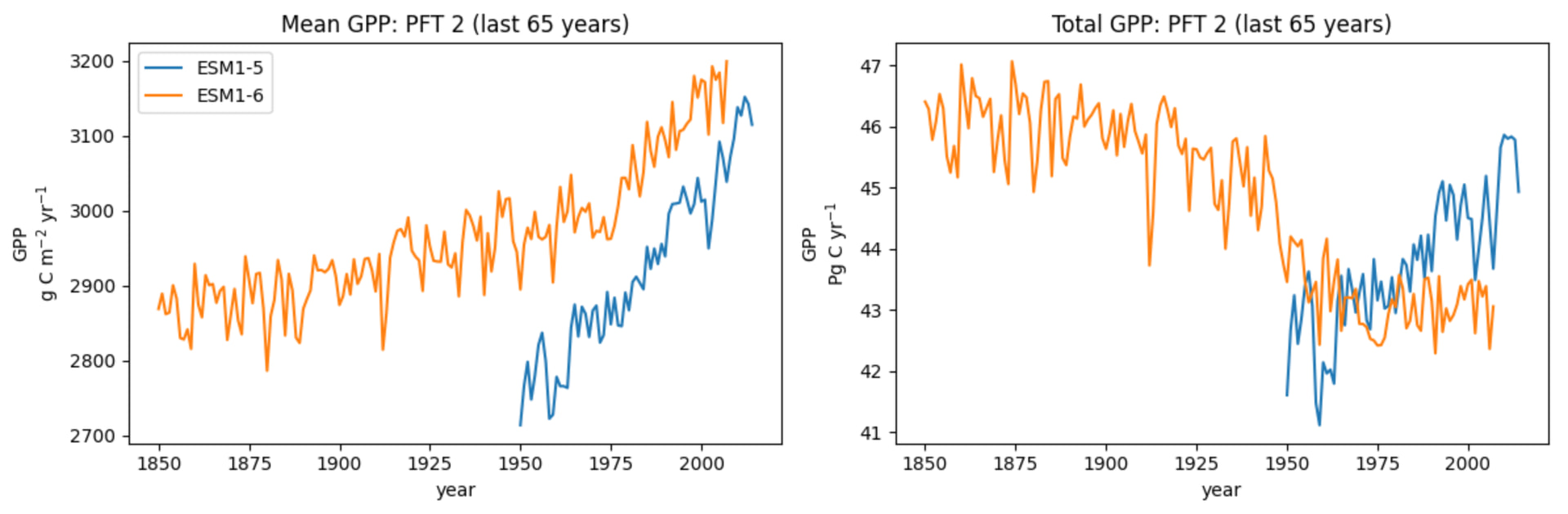
In ESM1.5 (right now I only have data from 1950-2014), there appears to be stronger historical increase in the average rate of GPP for EGBL and smaller reduction in area coverage, so the total flux (Pg C yr-1) goes up.
February 26th
For discussion
-
Discuss plans and goals for 2026
-
Latest ESM1.6 results
- Land-use change: Initial wood product pools, wood thinning and land cover change
Notes
-
Cautionary tale about phosphorus leaching rate parameter for CABLE-POP and TRENDY work – double check this if using phosphorus in TRENDY config.
-
Discussed latest ESM1.6 results.
2026 Priorities and Timelines
-
CABLE4 and ACCESS-ESM3: To help develop CABLE as a uniquely Australian component of ACCESS-ESM3, incorporating CABLE-POP (+BLAZE) will be important.
-
Developing CABLE4 for ACCESS-ESM3 is not only driven by desire to submit to CMIP7.
-
ACCESS-ESM3 + CABLE3 is a likely intermediate step. As part of this there is more testing needed to ensure CABLE is working with new UM version (13.1 currently, maybe 13.8 soon) - AM3 development already started down this track but ESM3 has particularities about how configurations join together (rivers, deposition, dust, chemistry, etc). Handling plumbing of variables and writing of outputs, time-step handling. Is CASA actually working in here as well (with C/N/P configs).
-
Land model is still a high priority and important component of ACCESS-ESM. It is a uniquely Australian developed model.
-
Goal: ACCESS-ESM3 with CABLE3 by end of 2026.
-
-
Finalise inclusion of urban tile in CABLE/ACCESS
-
Potential need for a higher level review of how CABLE-POP / TRENDY will integrate into CABLE4 for ACCESS. What are the priorities in terms of science. Technical barriers. Benchmarking to evaluate.
- Interactive phenology?
-
We will inevitably have to align priorities with forthcoming CSIRO structural changes. Priorities may shift in the coming weeks/months.
- We may need to do scoping and re-prioritizing following these changes.
-
Spend time on addressing the northern hemisphere seasonality bias:
-
E.g. systematic comparison of different Rh formulations (temp x water response functions)
-
Re-evaluation of nutrient cycles
-
Should be a coordinated effort with the others in the CABLE community: Some work already underway between Juergen and Matthias.
-
-
Potential to expand “Australian-isation” of CABLE. Other PFTs e.g. hummock grass? We could do more work on parameterization. Nutrients e.g. P.
- Currently limited by 17 tiles which are now all taken up
- Is it feasible to change from a fixed 17 tiles?
- Could better integration of ancillaries to say what parameters in what grid cells / tiles are read in. Circumvents 17 tile limit issues
- Potential for CASA structural code changes if we want other pools e.g. functionally active plant labile carbon
-
Develop capability to run ACCESS version of CABLE offline (same science for online + offline versions). Important if we want to participate in LMIP.
- Needs work on CMORisation of CABLE offline outputs (could build off ILAMB tree generator)
- Consider how weather generator is operating and if it needs revising
- Needs work on CMORisation of CABLE offline outputs (could build off ILAMB tree generator)
-
Documentation and publication plans
-
Need to allocate time this year to writing up ESM1.6 work
-
There is scope for land-focused paper with ESM1.6
-
There is also scope for a stand-alone paper on the Australian PFTs
-