CABLE4 planning: meeting notes

May 28th, 2026

Attendance: Alex, Claire, Lachlan, Ian, Rachel, Juergen

For discussion:

  • Processing the land cover for the CMIP7 Scenarios (high and low):
    • Progress has been made and code is being cleaned up for compatible python functions that can be applied to both the historical and scenario input data.
  • ESM1.6 1pctCO2, 1pctCO2-bgc and 1pctCO2-rad runs are done:
    • Results show reduced land climate (gamma_L) and co2 (beta_L) feedback parameters compared to ESM1.5. Compared to the CMIP6 ensemble, ESM1.5 was already low so ESM1.6 may be even lower again. Not inherently a bad result but will need to have a dig around to understand why we’re lower than ESM1.5.
      • Check regional patterns, initial conditions, climate drivers (perhaps an effect of lower mean global temperature in picontrol or changes in precipitation patterns over SAmerica).

June 4th, 2026

Attendance: Alex, Rachel, Ian, Jhan, Tilo

For discussion:

ESM1.6 Updates:

  • Concentration-driven historical run is going but not with formal ACCESS-NRI configuration release. Still awaiting that configuration to be finalised and will need to re-run.
  • Need to have the concentration-driven run finished (up to 1979) to get AMIP runs going too
  • CMIP7 LUMIP
    • Offline land model simulations with and without land-use change. Includes land-hist and land-amip.
    • Are we committed to contributing to this MIP? It is not a deliverable under any existing project and has always been left as a question mark as part of NESP.
      • Important to contribute to this LUMIP to position ourselves as land modeling experts in ACCESS and better position ourselves as the team leading land modeling across projects (TRENDY, CMIP).
    • Largely follows the TRENDY protocol but uses the same land model versions as those in the coupled models i.e. equivalent CABLE science as used in ACCESS-ESM1.6. This means .
    • Would require a few things in collaboration with ACCESS-NRI:
      • Requires running CABLE and ACCESS resolution
      • Regridding TRENDY forcing to ACCESS grid
      • Probalby need to choose an appropriate weather generator to convert daily TRENDY forcing into sub-daily forcing for CABLE. Consult with Juergen on this.
      • Set up gridinfo file properly with initial conditions
      • Ian flagged: We don’t have currently have capability to do land-use change (including thinning) in the offline CABLE model. Getting the same code into CASA should be straightforward but the I/O will be tricky, including MPI. Will need discussion with NRI team (Claire, Lachlan, others) on how to do this.
  • ESM1.6 pre-publication QC (led by Christine)

ACCESS-ESM1.6 Carbon Cycle Evaluation:

  • Land, ocean, atmosphere
  • Key metrics to look at?

ACCESS-NRI Land and Coupled Modelling Workshop – Abstracts due tomorrow

Fire in CABLE:

  • Ian has been working on getting BLAZE working without POP in a CABLE development branch. Implementing it into ACCESS would require bunch of extra work including new state variables, updating the restart, working through the large number of differences across CABLE branches between this dev branch and the ACCESS-ESM1.6 branch.

June 11th, 2026

Attendance:

For discussion:

ESM1.6 study design with Australian PFTs (Alex):

  • Discussed experimental design that will make use of ACCESS-ESM1.6 CMIP7 configs.
  • New piControl spinup required with new land cover map that includes all necessary tiles to be initialised, this includes necessary tiles for (i) NVIS+LUH3 version of Australian land cover, and (ii) Global ESM1.5+LUH3 version of Australian land cover (same processing used as global land cover in ESM1.6; no NVIS data incorporated).
  • This new spinup will allow us to branch off different historical (and subsequent AMIP) experiments to evaluate the impact of (i) updating the land cover distribution (no change in tree types/parameterisations i.e. PFTs 2 and 4 are in place of any new PFTs 12 and 13, respectively), and (ii) updating tree PFTs to include Australian PFTs 12 and 13 (where NVIS tells us to) which includes new parameterization and AusTraits data.

ESM1.6 Carbon Cycle Evaluation (Alex):

  • Results against the GCB show that ESM1.6 has largely improved across the board relative to ESM1.5
  • Further evaluation is needed. (i) Account for uncertainty and variability in the benchmarking data, (ii) look at evaluating the seasonal cycle of atmospheric CO2.

Action items:

Alex: Generate new land cover map for spinup of Australian experiment.

June 18th, 2026

Attendance:

For discussion:

Planned publications as part of CMIP7 to be logged on ACCESS Hive:

  • See here: CMIP7 Publications - ACCESS Hive Community Forum . Idea is to prevent duplication of effort and encourage collaboration.
  • Alex has already documented three planned publications: (1) Land model description for ACCESS-ESM1.6, (2) New Australian vegetation for ACCESS-ESM1.6, (3) Global carbon cycle evaluation (land+ocean+atmosphere).

ACCESS-ESM1.6 Land Cover for Scenarios:

  • First draft of H-Scenario land cover is available: /g/data/p66/ajn563/ACCESS-ESM/ESM1.6/luh3-1-1/scenarios/H-Scenario/ACCESS_vegfrac_scen_h.nc. This includes combination of Australian NVIS vegetation (with Aus PFTs) and global processing.
  • There are new tiles that appear in the scenarios that we never initialised in the spinup or historical period. What to do about these?
    • If we’re adding new crop and there’s existing grass in that grid cell, take fields (e.g. temperature, moisture, albedo, lai, etc) from the grass and assign them to the crop.
    • Consensus is that introducing new tiles during a scenario (in 2022) that were never initialised in the spinup or historical runs should be okay, so long as the required fields are given physically plausible values in the restart at the beginning of the run. This would require running Lachlan’s restart ancillary generation script to fill these tiles with grid cell or searched values (we can specify what rules to use) once to the restart before running to the scenario.
    • Rachel will test this out.
  • There is one problematic erroneous grid cell that was accidentally assigned 100% DBL in the historical.

(Claire) CABLE4 technical discussion:

Scoping and planning around fire in ACCESS:

  • Need a plan for this going forward. What are the priorities? What are user needs? What is ACCESS-NRI’s strategy around model support?
  • We should allocate some time as a group (CSIRO+others) to discuss if/when/how to bring fire into ACCESS.
    • E.g. which ACCESS model version to bring it into? What would be the applications and purpose going forward? What technical requirements would we need to consider such as integration with UM? How much back-porting would be required to get fire into ACCESS-ESM1.6 and the ESM version of CABLE3? OR should we just forge onto a CABLE4 and ACCESS-ESM1.6.
  • Who should be involved: Ian, Tilo, Rachel, Alex, Jhan, NRI folks

Action items:

Rachel to test scenario runs with new land cover and see what happens on new tiles.

Alex to generate land cover for VL-scenario to see if we get new tree PFT tiles appearing as well.

June 25th, 2026

Attendance: Tilo, Ian, Rachel, Alex, Jhan, Juergen, Lachlan

For discussion:

ESM1.6: Rachel is performing land cover change tests for the transition from the historical period to scenarios, to evaluate if we need to perform some adjustments to the restarts or not considering new, uninitialised tiles can appear in the scenario.

Fire in ACCESS – Scoping and Planning:

Presentation by Ian.

Aim: Fire module for an ESM.

No explicit representation of “ignition”.

Fire operates at the grid cell level, not at the tile level. One good reason to do it on the grid cell is that our tiles may be interpreted as mixed PFT ecosystems e.g. woodland could be grass+tree. Fires burn both. Restricting the fire to a tile makes it difficult for a fire the starts in one tile to propagate over to another tile.

Fire is re-established each day, there is not a strict rule to say a fire on day t must continue to day t+1. However, Ian has done some work in the stochastic application of fires so that you can get multi-day, longer running fires.

Technical challenges:

~18 new state variables from fire

3 new ancillaries (2 fixed, 1 annual, 1 needs to be converted to netCDF, 1 depend on land cover and climate): 1 is human population density, 1 is biome related.

i/o code needs to be rationalised

grid cell averaging in CABLE is not set up for USE in coupled applications (landpt% & patch% TYPEs). Ideally, we create an approach to grid cell averaging that can be used in multiple ways with any biophysical variable that is grid-cell average, not just some specialised function for fire.

implementation in ESM1.5/1.6 and ESM3 likely different. What are our expectations/requirements for portability across versions?

Science challenges:

See Ian’s slides

Other science priority considerations: A whole stack of science is laying around in the BIOS and CABLE-POP (TRENDY) development branches which we may also want to consider amongst our priorities for ESM3. POP, thermal acclimation, plant hydraulics, urban, phenology, TER seasonality,

July 2nd, 2026

Attendance: Alex, Rachel, Claire, Tilo, Ian, Lachlan

For discussion:

ESM1.6 Scenario Land Cover: New processing done for H-scenario and VL-scenario

  • Need to decide what to do with the erroneous tiles from the historical.
  • Check the new Tundra tile in the VL-scenario.
  • Once the scenario land cover maps are finalised, we can process the forest thinning.

ESM1.6 testing new, uninitialised tiles in a scenario:

  • Rachel has done tests with a continuation of 1 year of the historical run in 2022 using an updated restart that Alex created. This restart included the addition of new tiles for the H-scenario, so we should see new tiles appearing.

  • New tests:

    • May want to evaluate the C, N and P pools at these test grid cells that Rachel has evaluated.
    • May want to regenerate the new restart with Lachlan’s adjust restart script but incrementally remove different fields to see which one(s) trigger an error in the model.

Fire in ACCESS - follow up on last week:

  • ACCESS-NRI Priorities:
    • Most effort will be put towards ESM3 going forward. Ideally we also work towards that rather than try and implement fire in ESM1.6 and then have to redo it for ESM3 later anyway.
    • Claire noted that first priority in reconciling the code may be to get Ian’s fire development branch (BLAZE-9184) into the CABLE-POP-TRENDY dev branch, so that at least those different development branches of fire (also the NESP2pt9-BLAZE dev branch) are reconciled before we bring it into the CABLE3:MAIN branch.

July 9nd, 2026

Attendance:

For discussion:

ACCESS-ESM1.6:

  • Restart update for scenarios:
  • Rachel’s test runs may need to be re-run.
  • Ensemble historical runs (~10 concentration-driven and ~19 emissions-driven) are completed. Tilo is processing some results and will make them available:
    • Processed results for GPP, NPP, RH, TAS, PR, ocean and land net flux in:
      • /g/data/p66/txz599/cmip7_results/historical
      • /g/data/p66/txz599/cmip7_results/esm-historical
    • 10 ensemble members each, Tilo will update when next batch completed
  • Carbon cycle evaluation:
    • We should evaluate the NH seasonal cycle of CO2, we know that has some issues and I think it has gotten worse in ESM1.6. Rachel can advise on the best benchmarks for us to evaluate on that.
    • New ILAMB results are available here: /g/data/zv30/public/data/ILAMB_ESM16_Evaluation/ilamb_result/_build_07_07
    • Other robust benchmarks to look at?
      • For the land, see Gier et al. (2024).
      • Greening trends with LAI products (GIMMS LAI4g, GLASS, LAI3g). Compare directly to LAI. Alternatively, take greening trends from reflectance data or indices directly and post-processing our modelled LAI to better represent those indices. Both approaches have advantages/disadvantages.
      • Global/regional spatial patterns and seasonal cycle of LAI (GIMMS LAI4g, GLASS, LAI3g), GPP (FLUXCOM MTE, FluxSat, others), NBP (CAMS, Jena CarboScope, others), live woody biomass (Xu et al., 2021)
      • When should we use AMIP runs to do evaluation, rather than the hist or esm-hist? AMIP runs may more fidelity at capturing the physical climate.
      • Relationship between temperature, precip and carbon cycle variables? Correlations, ENSO relationships?

Australian vegetation experiments with ACCESS-ESM1.6:

  • New land cover maps ready to kick off new spinup
  • Preference for where to branch off a spinup run?
    • Probably best to kick off around year 100/101 that was the start of Jhan’s first official spinup run (after Martin had run ~100 years already which was also counted). Then, we keep an eye on the spinup and equilibration, and choose where to branch off a historical run. We ideally want the Australian experiments historical runs (concentration-driven) to kick off in the same place where we have production runs kicking off.
    • Probably: /g/data/vk83/prerelease/configurations/inputs/access-esm1p6/modern/pre-industrial/restart/2026.04.07
      • Taken from the config.yaml here: /g/data/p73/archive/CMIP7/ACCESS-ESM1-6/production/Ndep2-PI-CNP-concentrations/output000

Action items:

@lachlanswhyborn will make some adjustments to the adjust_restart_for_new_land_cover script to optionally leave the previous years tile fractions in place, rather than update them.

@alexnorton to update the scenario land cover map to extend out to 2101, just duplicate the 2100 year.

@alexnorton to follow up with Rhaegar and Romain on ILAMB results:

  • Which run did they process?
  • Can they include a hist and esm-hist?
  • @clairecarouge will try get these latest results up onto the ME Org website

July 16th, 2026

Attendance: Rachel, Ian, Tilo, Claire, Lachlan, Alex

Discussion:

Restart update for scenarios:

  • Rachel and Alex have worked on running the first year of the scenario (2022) where some new, uninitialised tiles appear.

  • Tests show:

    • Tiles with zero fraction in previous year (in the restart) and positive fraction in current year (in the restart) can give reasonable behaviour when all fields are remapped using Lachlan’s restart adjust script.
    • If we modify the previous year tile fraction in the restart so that any new, uninitialised tiles in 2022 have 1e-6 in the previous year as well, sometimes the land-use code is not triggered at all (1e-6 in 2021 but can also be 1e-6 in 2022 i.e. no change in fraction means land-use code is not triggered).
    • CASA appears to produce negative NPP so the plant pools don’t grow initially. This is not necessarily due to the new, uninitialised tiles. We have seen similar behaviour elsewhere during historical runs.
    • Some new tile points have soil phosphorus pools with negative values in the test year
    • Possible mismatch between forced minimum LAI set in the code and zero plant leaf carbon pool for new tiles.
    • By slowly removing the fields that get remapped in Lachlan’s script when updating the restart file, Rachel has figured out that the soil temperature fields seem to be the culprit that actually crash the model. Possibly issue with 0 kelvin fields being created when expected values should be up above 273 kelvin.

CABLE3 code maintenance and ESM1.6:

Future maintenance and development pathway for CABLE and its relationship with ESM1.6 and potential future Earth System Model version (ESM3).

Strategic Questions

  • There is uncertainty about whether ESM1.6 will be the final ESM1.x release. The decision will most likely be made outside of this group. However, the team can provide recommendations but ultimately must respond to whichever direction is chosen.
  • If ESM3 proceeds and receives ongoing support, it should become the primary focus for land model development. While NRI is supporting ESM3 infrastructure, scientific development support from CSIRO and other partners is not yet clear.
  • A near-term challenge is that NRI must prioritise development effort over the next 6-12 months without certainty around future scientific support.

Importance of ESM1.6 (ESM1.x)

  • ESM1.6 is expected to remain important for several years for applications such as large ensemble simulations and paleoclimate studies.
  • Any changes to CABLE or its library interface should preserve backward compatibility so that these existing use cases are not disrupted. In principle, the use of the CABLE library and tagged version of CABLE:MAIN in the active ESM1.6 configuration should preserve this.

Development Options

Two possible pathways were discussed:

  1. Continue maintaining and upgrading CABLE3.x

    • Retain as much compatibility as possible with ESM1.6 and potentially future ESM1.x releases.
    • Allows updates to be tested within the well-understood ESM1.6 coupled model framework.
    • However, maintaining backward compatibility requires substantial effort and may detract from future priorities around CABLE4 and ESM3.
  2. Transition to CABLE4.x

    • Aligns with the requirements of ESM3.
    • Represents a more forward-looking development path but may reduce compatibility with existing ESM1.x configurations.

Recent CABLE3 development

  • Lachlan has developed an updated version of CABLE3:MAIN that can be tested within ESM1.6.
  • The update addresses an inconsistency where transpiration and root water uptake were calculated in separate locations, allowing physical inconsistencies (e.g. transpiration occurring without root water uptake).
  • The new implementation:
    • Consolidates several code versions arising from previous work by Vanessa.
    • Centralises the calculations into a single location with configurable options.
    • Ensures transpiration and root water uptake are calculated consistently.
  • Initial testing (~2 years of simulation) indicates the model runs successfully with the updated code.
  • No additional testing done yet. May not need it unless we have broader scientific applications/questions.

Action Items:

  • Alex and Lachlan: Can we add an item to the agenda of the ACCESS-NRI Land modeling workshop that discusses the issue of maintaining CABLE3:MAIN as compatible with ESM1.6 so we can discuss amongst the community. Put the immediate issue on peoples radar.
  • Rachel and Alex: Test new restart creation that does not include the inserted 1e-6 in the “PREVIOUS YEAR SURF FRACTIONS (TILES)” for the new, uninitialised tiles for scenario.

July 23th, 2026

Attendance: Rachel, Tilo, Claire, Lachlan, Alex

Discussion:

Australia Experiments with ACCESS-ESM1.6 (Alex):

  • New experimental configuration for testing impact of remapping Australian vegetation with NVIS and introducing two new tree PFTs
  • New piControl run started that includes updated land cover map with all required tiles activated so they can spinup. Restart taken from here:
    • /g/data/p73/archive/CMIP7/ACCESS-ESM1-6/production/Ndep2-PI-CNP-concentrations/restart000/
  • Spinup has run ~100 years. All looks good but likely need another 50-100 years to equilibrate.
  • Current results here: /g/data/p66/ajn563/ACCESS-ESM/ESM1.6/piControl-Aus-Exps/archive/

ACCESS-ESM1.6 Land-use change bug (Rachel):

An issue has been flagged where redistribution of fields due to LUC over soil/snow layers may not be handled as expected.

Jhan coded up a fix, Rachel tested. Results didn’t change when we expected they should. Rachel has coded up other test fixes, results still didn’t change. With latest set of changes, Rachel has found:

  • Using Lachlan’s adjust restart script, by filling the top soil layer but not the rest, the model gives sensible results after 1 month of running.
  • However, by filling the lower soil layers (just excluding the top layer) the model doesn’t give sensible results.

See issue here: https://github.com/ACCESS-NRI/UM7/pull/213

When we know there are new tiles being activated (e.g. when running the scenarios with new land cover), the minimum requirement is that the soil moisture fields must be filled using Lachlan’s adjust restart script.

Open questions:

  • Need to understand why Rachel’s latest scenario test run failed, when we have a new tile coming into existence.
  • Unclear how much impact this will have on conservation of water (via soil moisture) and energy (via soil temperature).
  • We have already run the historical runs. Should this fix be put in place for running the CMIP7 Fast Track scenarios? Likely answer is no but we must ensure the new tiles are be activated properly, so careful testing and handling of restart is required. Open question as to how this should be done with the esm1.6 configs.

Action items:

@lachlanswhyborn to follow up with Spencer on best approach to integrate restart update for scenarios into scenario config

@RachelLaw will continue testing land-use change bug

July 30th, 2026

Attendance: Alex, Ian, Claire, Lachlan

Discussion:

ACCESS-ESM1.6 Scenarios:

  • Bug-fix in land-use change code has been tested and run for the H-scenario and VL-scenario, with newly active tiles filled at the start of the scenario for selected variables (using Lachlan’s adjust restart script config yaml file; variables set in the config yaml are consistent with what’s updated in the land-use change code, but excludes the CNP pools or LAI, as they are dealt with inside the code fine anyway).
    • H-scenario with concentration-driven test configuration has run ~58 years (Rachel: /g/data/p66/rml599/scenarios/test-scenH-newcode)
    • VL-scenario with concentration-driven test configuration has run ~5 years (Rachel: /g/data/p66/rml599/scenarios/test-scen7-vl-nothin/)
  • The bug fix leads to improvements in the water balance closure over the land (see figures below). With the bug fix in place, the residual imbalance is similar to what we saw for the piControl runs (which have no land-use change). With the bug, the imbalance is still quite small and unlikely to impact carbon cycling by any noticeable amount.
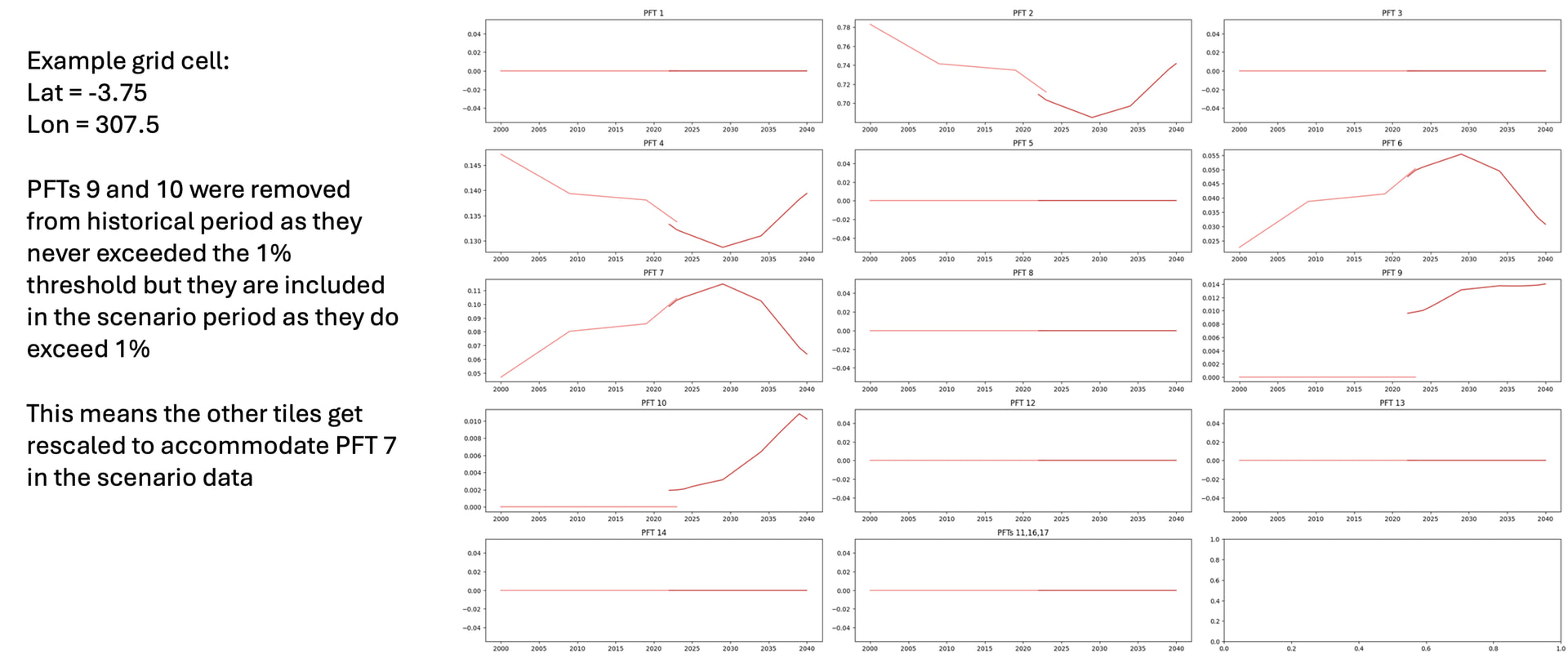
  • Issue in current scenario land-cover files: Due to the fact we must process the historical and scenario data separately and that we apply minimum thresholds (1% cover) to keep a tile active, then renormalise the remaining tiles to sum to 1, there are tiles that appear in the scenario that weren’t in the historical (mostly crop and grass tiles). Because of this, we have noticed that there is less forest cover in the scenario forcing for 2022 than in the historical forcing, due to inclusion of crop+grass tiles in the scenarios that were excluded from the historical (the fractions never exceeded 1%), after renormalisation, this (1) leads to a slight reduction in area fraction of other tiles, which is most notable for forest tiles, and (2) a small spike in land-use change emissions. The step change is no more than 1.5% for the sum of forest tiles, but this is similar in magnitude to the year-to-year land cover change in forest fractions around that period [see figures below].
    • Need further testing with thinning switched on to see if this spike in land-use change emissions is noticeable.
    • If it is noticeable, investigate if a fix is possible to linearly ramp up the newly active tiles from 2022-onwards and then renormalise to smooth over the step change in area fractions.
  • Land-use change thinning files have been created and are ready for testing. See input files for ACCESS here:
    • H-scenario: /g/data/p66/ajn563/ACCESS-ESM/ESM1.6/luh3-1-1/scenarios/H-Scenario/LUH3_cable_thinning_frac_from_bioh_scen_h_2022-2101.nc
    • VL-scenario: /g/data/p66/ajn563/ACCESS-ESM/ESM1.6/luh3-1-1/scenarios/VL-Scenario/LUH3_cable_thinning_frac_from_bioh_scen_vl_2022-2101.nc

[postponed to next week when we have more meeting attendance] ACCESS-NRI Scientific Advisory Committee (SAC): Input on what the major science priorities will be in 10 years’ time. The SAC will be developing a science roadmap for ACCESS and we are seeking input from the community.

Action items:

Alex (@alexnorton ) and Ian (@inh599) to include the land-use change code bug as a known issue in the ACCESS-ESM1.6 land paper.

Ian (@inh599) to add an issue to AM3 to bring across the bug fix of the land-use change code from ACCESS-ESM1.6.

Alex (@alexnorton) and Rachel (@RachelLaw) to test two scenarios with thinning switched on.

Figures:

Results of water balance improvement with bug-fixed land-use change code for H-scenario test configuration (no thinning), courtesy of Ian:

Results showing small discontinuity in land-cover between historical and scenario periods, due to different time period where we apply the 1% minimum threshold and renormalisation.

Results showing the discontinuity in total forest fraction (sum of PFTs 1,2,3,4,12,13) in the year 2022 for the historical forcing and the scenario forcing. This is compared to the annual land-cover change for the same PFTs:

Results showing the discontinuity in total crop fraction (sum of PFTs 9,10) in the year 2022 for the historical forcing and the scenario forcing. This is compared to the annual land-cover change for the same PFTs. It shows that most crop tiles increase in area in the scenario data for 2022, which is the main reason why forest area decreases.

August 6th, 2026

Attendance:

Discussion:

ACCESS-ESM1.6:

  • Scenarios with thinning: Setting up scripts to update the restart for scenario land-cover and wood thinning.
  • Discontinuity in land cover fractions between historical and scenario:
    • Would it be acceptable to apply a linear ramp up for new tiles? This way, the new tiles don’t lead to a artificial step change of 1-2% in land cover fraction. This would mean applying an adjustment to the LUH3 input data over a n year period at the start of the scenario e.g. 5 years.
    • First step: Test the scenario runs with wood thinning switched on, then see how significant the land-use change emissions anomaly in 2022 is.
    • Second step: If it is too large to ignore, then we may apply a linear ramp up of area fraction for new tiles.

Schedule next CABLE4 meeting:

  • Upcoming ACCESS-NRI workshops (AI/ML Workshop 19-21 August and Land/Coupled Workshop 31 Aug to 2 Sep). We will cancel the CABLE4 meeting on August 20.

August 20th ,2026

Attendance: Alex, Ian, Rachel, Lachlan, Claire, Jhan, Juergen

Discussion:

TRENDY 2026:

S0-S6 experiments: Standard S0-S3 runs, then S4-S6 are with land-use change switched off but with the different driver combinations for each.

ACCESS-ESM1.6:

Scenarios with thinning: Test run for first 10 years has completed. Results still show a substantial discontinuity in land-use change emissions, which warrants further efforts to fix the issue in land cover fractions over the transition period between the historical->scenario.