CM3 Dev-Eval Working group meeting minutes
Meeting link
Date: Tuesday 23 June 10:30 am
Participants: @kieranricardo, @inh599, @MartinDix, @cbull, @wghuneke, @ariaan, @ShayneM, @ClaireT, @ezhilsabareesh8, @JulieA, @zoegillett27, @paulleopardi, @Heather_Leasor, @Harun_Rashid
Chair: @kieranricardo
Minutes: @spencerwong
Subscribe to the ESM Working Group calendar as follows:
- ESM Working Group Meeting Calendar feed (right click on the link and copy the URL)
- Use calendar feed URL to subscribe to the calendar
Agenda:
- Latest model developments and new simulation
- shout-out props for figures from @kieranricardo
- Discussion on the workshop hackathon.
New simulation and model developments
- A new CM3 simulation is currently underway. This includes a new ocean grid from OM3 to make the polar regions B grid compatible, which helps with the issue of tall sea ice towers. The simulation also includes the new iceberg spreading pattern from OM3. Snow accumulation over the ice sheets is now redistributed according to a climatological pattern. Minor fixes to the wind stresses are also include.
GitHub issue links:
GitHub issue links to OM3 figures for CM3:
Community figures
- @kieranricardo iceberg flux in new simulation

The figure above shows the 40 year mean iceberg water flux into the ocean. Half of the snow accumulation on the ice sheets is input along the coast (not shown) and the other half goes into the above iceberg flux. Latent heat is accounted for in both the coastal and iceberg melt. This doesn’t seem to cause as much of a problem of excessive sea ice thickness as seen in OM3. An interpolation issue at 180 degrees was identified in the above figure.
- @kieranricardo bottom age tracer:

The figure above compares the bottom age tracer in the previous CM3 simulation to OM3. It shows excessive bottom water formation in CM3, as discussed previously.

The above figure shows the bottom water age in the new CM3 run. It looks slightly improved, however differences may be related to the short length of the run so far, and we will need to compare again after more years of output are available.
-
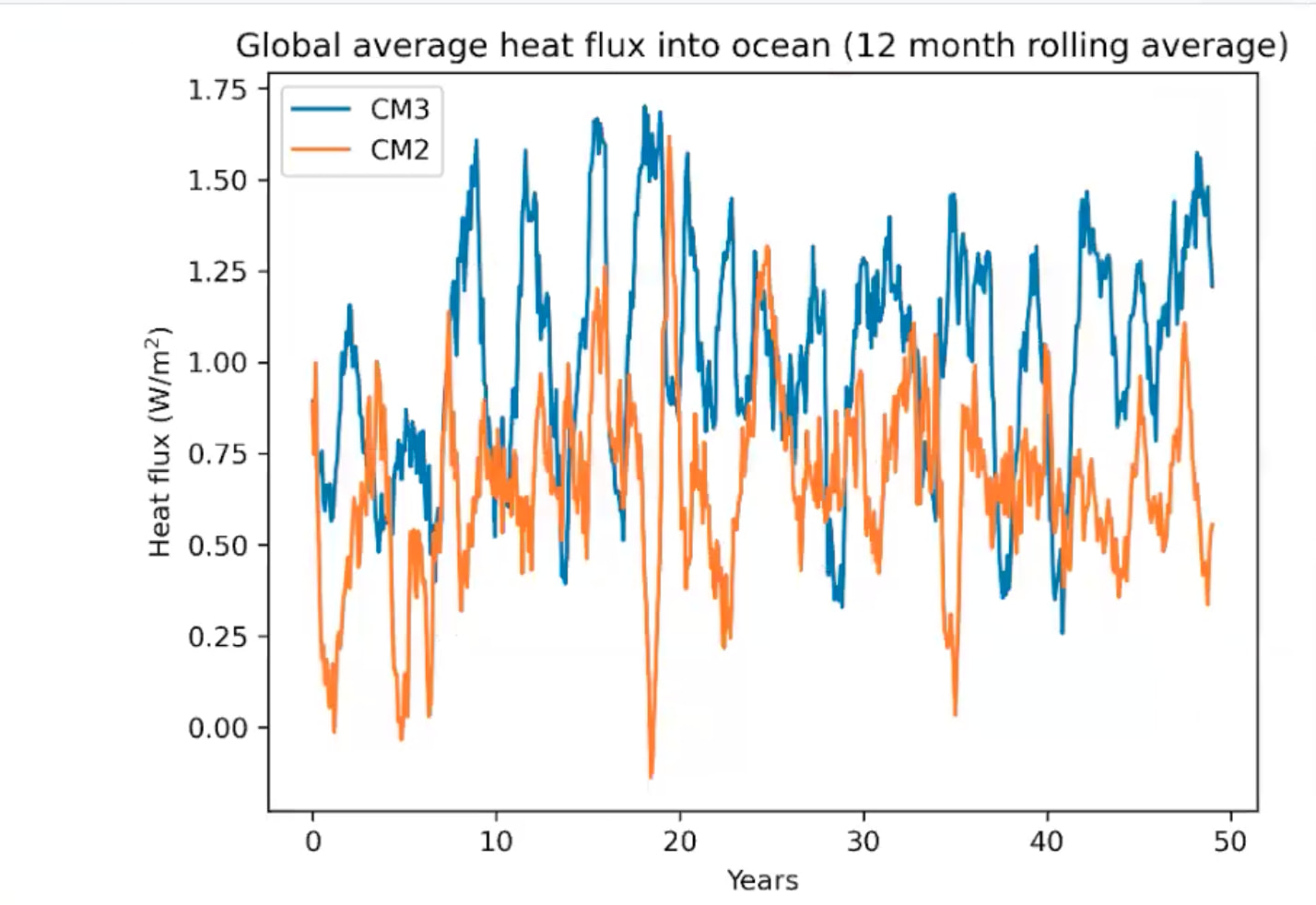
@kieranricardo Heat flux into ocean:
The above figure compares the global average heat flux into the ocean for CM2 and the previous CM3 simulation.The above figure shows the data for the new CM3 simulation. The new run is further away from radiative imbalance.
As it’s further from radiative balance, the SST cold shock at the start of the run is less severe. The following figures compare the global SSTs for the old and new runs respectively:


-
@kieranricardo Sea ice area and thickness
Sea ice area is improved in the new run (second figure) compared to the previous run (first figure)
However sea ice volume in the arctic has only slightly improved. A similar issue is seen in OM3, potentially related to a problem in the wind mapping around the pole.


Future plans
- Planning to put together a PI control run, with a goal of having it ready for the hackathon.
- Also plan to update the UM version to 13.8, allowing us to use the GC5 central configuration, and incorporate cable.
Hackathon at the September ACCESS Community Workshop on Land and Coupled Modelling:
-
The third day of the workshop will be a hackathon/discussion day. There will be a session on evaluating the new ACCESS models including CM3. To support initial discussion during the session, we’re hoping community members will be able to bring some pre-prepared figures with them. Further analysis can be performed later in the session based on the initial discussion.
-
We’ll need a new run ready a few weeks prior to the workshop to allow time for people to put together new analysis and figures.
-
We’d love to get as much involvement in the hackathon as possible. Let us know if there’s any way we could help, such as areas for training.