CM3 Dev-Eval Working group meeting minutes
Meeting link
Date: Tuesday 31 March at 10:30 am AEDT
Participants: @RachelLaw, @MartinDix, @JulieA, @kieranricardo, @Harun_Rashid, @AndyHoggANU, @wghuneke, @Heather_Leasor, @Dietmar_Dommenget, @cbull, @sofarrell, @spencerwong, @DeepashreeDutta, @joshuatorrance, @ctychung, @zoegillett27, @jemmajeffree, @HIMADRI_SAINI
Chair: @kieranricardo
Minutes: @spencerwong
Subscribe to the ESM Working Group calendar as follows:
- ESM Working Group Meeting Calendar feed (right click on the link and copy the URL)
- Use calendar feed URL to subscribe to the calendar
Agenda:
- Updates from CM3 technical meetings: The previous simulation completed 100 years and has now been stopped. Work is going on to prepare for a new simulation which will include improvements to masks in the polar regions, and fixes for issues with wind stresses. The reproducibility bug has now been resolved, meaning that repeating identical runs will produce identical results.
- CMIP7 fast track and the IPCC Assessment Report:
- @AndyHoggANU discussed the timeline for evaluation papers to be included in the AR7 report. Fast track data will be coming out soon, and papers need to be submitted by March 2027 in order to be cited by the report. We would like to understand how NRI can support, encourage or help researchers write papers based on the fast track.
- Meetings/workshops are being planned later in the year, with one focused on the Australian region, and a NRI ESM and Land workshop planned for September, which will include CMIP as a focus.
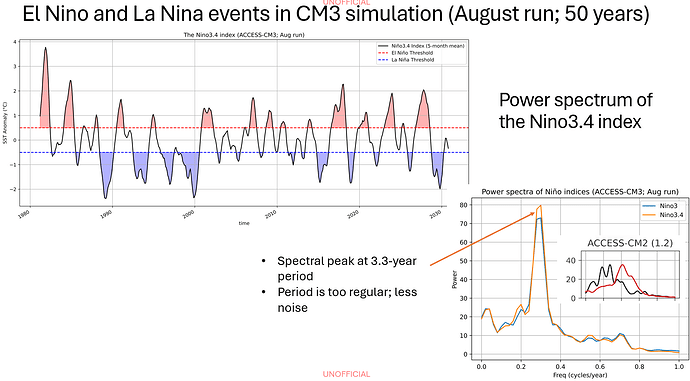
- For ESM1.6, NESP will be planning an evaluation paper on ENSO, drivers, and mean states.
- shout-out props for Figures from: @AndyHoggANU, @sofarrell
- ESM and land community workshop:
- We are planning a 3 day ESM and Land workshop for early September, which will include science presentations, training, and likely a hackathon. If you have any ideas of things you would like to see, or ideas for invited speakers (for example someone visiting from abroad, or someone working in Australia) contact any member of the program committee (@wghuneke, @JulieA, @alexnorton, @lachlanswhyborn, @HIMADRI_SAINI, @spencerwong, @adisen99, @zoegillett27).
- offer support (breakout room?) to people wanting to get involved / could set aside 10 minutes at end of meeting to answer questions.
GitHub issue links:
GitHub issue links to OM3 figures for CM3:
Community figures
@AndyHoggANU
Freshening of Labrador sea and North Atlantic, from Arctic, Greenland and North America (via St Lawrence River) stabilizes the region and shuts off convection cools surface, showed strong trend since in last month trend plots, Arctic ice thickens to > 8m. Also seen in CM2-025 but centuries to occur and FW flux to build up, different ocean mixing scheme used in CM2 (KPP). In CM3 (ePBL) mixing tends to increase stable ocean conditions with the FW flux.
Further to Wilma’s analysis from January, here is a figure I showed at the CMIP workshop recently. Confirms that OM3 gives improved Antarctic dense water at 25km resolution, but that CM3 is still not great. Not only is there excessive open ocean convection, but it is also very salty on the shelf.
MLD shows the open ocean convection.
Sea ice is also pretty different (causality isn’t clear to me).
There was discussion around whether the mixed layer depth figures suggest open ocean convection, or instead excessive mixing that is unrelated to large polynyas. Plotting the DSW exports was suggested as a way to confirm whether the younger bottom water in CM3 is caused by the deep offshore mixed layers, or if it’s instead coming from the shelves.
Discussion also centred around the iceberg spreading scheme. Currently, all freshwater is spread over a large pattern around the ice sheets, which may be contributing to the excessive salinity over the shelves. An updated scheme which allocates a fraction of the freshwater to the coast is being worked on. There is interest in performing a test run without the iceberg spreading, so that all freshwater is input around the coast. Additionally, interest was raised in comparing the total iceberg fluxes in CM3 and OM3.
@sofarrell
Over the coarse of the run there is strong surface freshening, especially in the Arctic. The CM2 025 simulation had a similar freshening kick in near the end of the run, whereas it happens quite quickly with CM3. Convection in the Labrador sea gets shut down and surface temperatures become much colder.
The age tracer at 30E shows ventilation at the coast, but not further out. Mixing extends to 500m in some regions but doesn’t appear to extend further down.
40W also shows water coming down the slope, but doesn’t show mixing to the bottom away from the coast.
At 160W 50 years into the run, a coastal polynya did occur around 76S. There is evidence of quite strong mixing down to ~400m in the temperature data. However there isn’t evidence of brine mixing in the salinity data.
The EPBL mixing scheme appears to keep things more stably stratified.
Please paste here and include a caption!