ESM working group: Meeting notes 2024/2025

Date: 27/2/2025
Participants: 17
Chair: @tiloz

  1. Opening and welcome:
  • There are no speakers confirmed for future meetings. Please consider presenting, or inviting a colleague to present. Members are encouraged to reach out to @spencerwong or any co-chair if they are interested in presenting.
  • PhD students and early career researchers are encouraged to present. Presentations to the ESM WG can be an opportunity to receive early feedback from the community on in-progress work.
  1. Shared Resources and Experiments:
  • ESM project lg87 has used 470 KSU of its 875 KSU allocation for this quarter. /g/data storage has grown to 54.3TB of the 100TB allocation.
  • Georgina Falster has a plan for large runs using ACCESS ESM1.5, which should be able to begin this quarter.
  • Do you have any proposals for shared experiments? See guidelines for how to do this. There are often used resources we can access if there are projects to use them.
  1. CMIP7 Fast Track Presentation:
  • Pearse Buchanan presented results from a long spin-up simulation of a prototype ACCESS ESM1.6, focusing on the ocean biogeochemistry.
  • The 650 year simulation included new WOMBAT-lite ocean biogeochemistry, and the iceberg freshwater distribution scheme. Land/atmosphere changes will be incorporated in the future.
  • Ocean physics
    • Ocean temperature and salinity show small downward are downward trends which are within the range of variability. Surface temperature and salinity are quite stable, while the total volume and mass of ocean trend upwards.
    • The heat budget has slight positive bias, however will require further analysis. The freshwater flux is balanced appears balanced.
  • Ocean BGC
    • Carbon and alkalinity have small drifts, however with magnitudes not significant enough to cause concern.
    • Oxygen, alkalinity, and iron show larger drifts, and will require further investigation. Results may be impacted by a conservation bug present at the start of the run, though subsequently fixed.
    • Despite issues in the deeper ocean, surface iron looks good compared to observations, as do chlorophyll and CO2 fluxes.
      Next steps:
    • Investigate cause of drift in oxygen and iron, considering changes in age, and overturning.
    • Incorporate parallel updates to CABLE into the spinup simulation.

Presentation slides:
2025-02-27 ACCESS-Hive Earth System Modelling group.pptx (8.2 MB)

Additional information

Date: 13/3/2025
Participants: 12
Chair: @ShayneM

  1. 2025 ACCESS-NRI Community Workshop Training Day Poll:
  • @jasmeen_kaur introduced the online poll for voting on training topics for the Training Day at the ACCESS-NRI Community Workshop.
  • The poll is available here and voting is open until the 31st of March.
  1. Upcoming Science Presentations
  • Science presentations from Hannah Dawson and Wilma Huneke are scheduled for the next March 27 and April 10. . will be Shayne McGregor emphasized the importance of science presentations and encouraged contributions from both researchers and students.
  • Community members are encouraged to present at the working group meetings. Presentations can be on works in-progress, and students are especially encouraged to present.
  1. Shared Resources and Experiments:
  • ESM project lg87 has used 535 KSU of its 875 KSU allocation for this quarter. /g/data storage remains at 54.3TB
  • Georgina Falster is currently running experiments with ACCESS ESM1.5, which will likely use up the remaining compute for this quarter.
  • Do you have any proposals for shared experiments? See guidelines for how to do this. There are often used resources we can access if there are projects to use them.
  1. Science Presentation:
  • Liam Cassidy, a PhD candidate at the University of Melbourne, presented his research on temperature extremes under net zero CO2 conditions. His work focuses on understanding regional climate changes and temperature extremes after achieving net zero CO2 emissions.

  • The research utilized data from the Zero Emissions Commitment Model Intercomparison Project (ZECMIP), which includes idealized experiments to understand global and regional climate responses to net zero CO2 emissions. Experiments from the MIROC-ES2L, UKESM1-0-LL, and ACCESS-ESM1.5 models were compared.

  • The study analyzed three branching experiments based on cumulative CO2 emissions levels: 750, 1000, and 2000 petagrams, involving an initial phase of increasing CO2 emissions (1% per year) followed by an instantaneous transition to net zero emissions.

  • The study compared temperature and precipitation anomalies, as well as the scaling of temperature extremes, between the warming and net zero periods.

  • Findings:

    • Significant model diversity was observed in regional temperature changes after net zero emissions. Some models showed cooling over land, while others indicated continued warming, particularly in the 2000 petagram scenario. However, models were consistent in showing Southern Ocean warming after net zero.
    • Localized cooling was often associated with increased precipitation, while warming regions tended to experience decreased precipitation.
    • TXx scaling was investigated to understand whether changes in regional hydrology impact changes in temperature extremes after net-zero. TXx scaling generally decreased after net zero, though changes were heterogeneous in space with diversity between the models.
    • Focusing on South Africa, changes in westerly wind patterns, precipitation, and soil moisture changes were linked to changes in temperature extremes. The study highlighted the importance of understanding local feedback mechanisms, such as soil moisture and evaporative fraction, in moderating temperature extremes, as well as the value of taking a storylines approach for analysis.

These notes were partially generated by AI. If you notice any errors or omissions please feel free to modify directly, or message @spencerwong.

Additional information

Date: 27/3/2025
Chair: @dkhutch

  1. 2025 ACCESS-NRI Community Workshop Training Day Poll:
  • A reminder was given about the poll for training sessions at the 2025 ACCESS-NRI Community workshop training day. Voting is now closed.
  1. Shared Resources and Experiments:
  • ESM project lg87 used nearly all of its 875 KSU allocation for quarter 1. /g/data storage remains at 54.3TB
  • There are often opportunities at the end of the quarter to apply for spare resources from other working groups near the end of each quarter. Having experiments prepared and visible proposals on the Hive forum helps make this possible.
  • Proposals are now open for quarter 2. Do you have any proposals for shared experiments? See guidelines for how to do this. There are often used resources we can access if there are projects to use them.
  1. Science Presentation:
  • Hannah Dawson presented on Using ACCESS CM2 to investigate the role of ocean warming in Antarctic sea ice loss.

  • The in-progress study aims to understand how deeper ocean warming impacts Antarctic sea ice.

Background

  • The past two years have seen record low winter Antarctic sea ice extents, well outside the range of historical observations. Recent work investigating the causes of this decline suggest that the ocean has played a significant contribution to this decline, which may suggest a regime shift.

Experiments

  • Initial condition perturbation experiments with ACCESS-CM2 were run, where warming was applied to the upwelling branch in the ocean restart files. Several warming regions were tested. The final warming area was defined based on a density, temperature, and depth constraints. Ten ensemble members were run branching from different points of the PI control simulation.

Results

  • Over time, subsurface heat added in the Southern Ocean spreads into the surface mixed layers.
  • Significant reductions in sea ice extent and volume were observed, particularly in winter and spring. The response was more pronounced in certain regions, such as East Antarctica.
  • The reductions in sea ice were closely aligned with regions experiencing increased
    ocean temperatures, suggesting a direct link between the warming and sea ice loss.
  • Sea ice declines were driven by increased basal melt rather than decreased freezing rates.
  • Increases in sea surface temperatures and surface air temperatures were observed in the Southern Ocean. Changes were also observed in sea level pressure, however further analysis is required in interpreting the changes.

Future work

  • Future work will investigate into the relative roles of the applied ocean warming and atmospheric feedbacks in the sea ice decline.
  • Other areas for investigation will include understanding the pattern of surface freshening that occurs in the Southern Ocean.

These notes were partially generated by AI. If you notice any errors or omissions please feel free to modify directly, or message @spencerwong.

Additional information

Date: 10/4/2025
Chair: @tiloz
Participants: 13

  1. Next Working Group Meeting:
  • The working group meeting scheduled for 24/04 has been cancelled, as many working group members will be away between the public holidays. Working group meetings will return on 08/05.
  • There are no speakers confirmed for future meetings. Please consider presenting, or inviting a colleague to present. Members are encouraged to reach out to @spencerwong or any co-chair if they are interested in presenting.
  1. Brief CMIP7 update:
  • New spinup simulations of ESM1.6 are currently in progress. These simulations combine ocean and land model developments from the last few months. The ESM WG meeting on 08/05 may be used to provide an update on the new spinup.
  1. Shared Resources and Experiments:
  • ESM project lg87 used 411 KSU allocation for quarter 1. /g/data storage remains at 54.3TB.
  • @georgyfalster’s tropical SST variability experiments have been allocated 500 KSU, and there are currently no other proposals for this quarter.
  • Proposals are now open for this quarter. Do you have any proposals for shared experiments? See guidelines for how to do this. There are often used resources we can access if there are projects to use them.
  1. Working group day at the 2025 ACCESS-NRI Community Workshop:
  • The format of the ESM WG meeting and 2025 ACCESS-NRI Workshop was discussed. Planning is not currently advanced enough to provide concrete details. The idea of holding a joint session with another working group was raised, due to the ESM working group’s overlap in interests with the other working groups.
  1. Science Presentation:
  • Wilma Huneke presented on The ACCESS-CM2 climate model with a higher resolution ocean-sea ice component.
  • Background:
    • A new configuration of ACCESS-CM2 was set up, where the ocean and sea ice resolution was increased from 1-degree to quarter-degree. The atmosphere component was left unchanged from the existing CM2 configurations.
    • The ocean resolution matches the quarter degree OM2 configuration, allowing for investigation both the effects of the higher resolution, and the effects of the coupling.
    • Changes in bathymetry were required to prevent model crashes, and the regridding method for wind stresses was also changed from bilinear to patch to prevent an imprint of the atmospheric grid appearing in the regridded data.
  • Results:
    • A 500 year present day simulation was run with higher resolution model. Analysis focused on the final 100 years of the simulation. Comparisons were made with 1 degree CM2 present day experiment, and 0.25 and 1 degree OM2 simulations using repeat year forcings.
    • Sea surface temperature drifted over the whole simulation. Ocean interior temperatures drifted towards different values for each model/configuration, however the higher resolution simulations appeared to equilibrate faster.
    • Many biases seen in the 1 degree coupled model also appear in the 0.25 degree coupled model, including a large Southern Ocean warm bias which is larger in the higher resolution model. SST biases in eastern upwelling regions show similar patterns between the two models.
    • Ocean energetics as measured by sea level standard deviation were best represented in the coupled 0.25 degree model, while all analysed models generally underestimated this quantity.
    • All models show issues in surface mixed layer depths, with extra deep convection areas in the Wedell Sea and Ross Sea. Quarter degree OM2 significantly overestimates deep convection in the North Atlantic. The quarter degree coupled model appears to do the best job, however still shows biases.
    • The quarter degree coupled model shows similar biases in the ENSO pattern as the one degree model, however has an improved ENSO lifecycle, with less of a biennial cycle.
    • The quarter degree coupled model also displace a spurious North Atlantic multi-decadal variability, with simultaneous oscillations in the North Atlantic SST anomaly and overturning, related to the interplay between fresh water anomalies and AMOC strength. This was not present in the one degree model, however has appeared in other coupled models.
  • Future work:
  • Future work could include further increasing the ocean resolution or increasing the ocean vertical resolution.

Additional information

Date: 22/5/2025
Chair: @ShayneM
Participants: 13

Agenda Items:

  1. Science Presentations and Scheduling
  2. Shared Access NRI Resources
  3. AAF Authentication
  4. Science Updates: ACCESS-ESM 1.6 and CMIP7

Detailed Summary of Discussions:

  1. Science Presentations and Scheduling

    • Future science presentations are being planned, with Dietmar scheduled for the next meeting in early June.
    • Rachel Law suggested a follow-up session due to the volume of updates.
  2. Shared Access NRI Resources

    • The team has used 820 of 875 KSU for the quarter.
    • Strategy: use resources early to qualify for additional allocations.
    • Some members (e.g., Georgy) may still need more resources.
  3. AAF Authentication

    • Aidan Heerdegen explained the switch to AAF (Australian Access Federation) for easier and more secure logins.
    • Encouraged everyone to enable AAF for better reporting and access continuity.
    • Pointed out the Draft ACCESS-NRI Workplan and encouraged feedback from community.
  4. Science Updates: ACCESS-ESM 1.6 and CMIP7

  • Presented by Rachel Law and Tilo Ziehn:
    • ACCESS-ESM 1.6 is being prepared for the CMIP7 fast track.
    • Focus areas:
      • Model development and infrastructure.
      • New Australian-specific vegetation types (mesic and xeric).
      • Transition to CABLE and CASA-CNP for land biogeochemistry.
      • Ocean biogeochemistry updates using Wombat Lite.
      • Spin-up runs exceeding 1,000 years to ensure model stability.
      • Salinity issues in the Mediterranean due to model configuration.
      • Climate sensitivity estimated at ~3.5°C (lower than ESM 1.5).
  • CICE 5 ocean model integration is progressing well.
  • Land and ocean carbon fluxes are stable and near zero, enabling potential emissions-driven simulations.
  • Vegetation modeling is prescribed but includes productivity feedbacks.
  • Mediterranean salinity is a known issue; potential fixes include adjusting sill depth or mixing parameters.

Decisions Made:

  • Dietmar will present at the next meeting in early June.
  • The team will continue to monitor and manage the use of shared access NRI resources.
  • Members are encouraged to enable AAF authentication for better reporting and access continuity.

Action Items:

  • Rachel Law to schedule a follow-up session for further updates.
  • Team members to consider future resource needs and communicate them.
  • Aidan Heerdegen to provide further guidance on enabling AAF authentication.
  • Continue model development and address the Mediterranean salinity issue.

NOTE: These minutes were generated using AI. Please feel free to correct any mistakes directly, or message @Aidan with corrections.

Additional information

Date: 05/06/2025
Chair: @spencerwong
Participants: 9

1. Admin and resource usage

  • Science Presentations: No upcoming presentations scheduled. Members encouraged contact the ESM WG co-chairs or @spencerwong to propose a topic.
  • LG87 Resource Usage:
    • 836 of 875 KSUs used this quarter.
    • Storage usage at 55.2 TB of 100 TB allocation.

2. 2025 ACCESS Community Workshop – Working Group Day and ESM WG organisation

  • Scheduled for Friday, 12 September 2025.
  • Currently unclear who is responsible for organising the ESM WG meeting at the Community Workshop. ACCESS-NRI will provide rooms and catering; content planning is up to the group. @jemmajeffree to follow up with @dkhutch on how last year’s meeting was planned, however additional people are needed to lead the planning.
  • The format for last year’s workshop, with a single track session of presentations, was seen as successful and a model to follow for this year.
  • Lack of clear message that the ESM WG day is for anyone involved in coupled system research rather than just technical model development.
  • Discussion on organisation of ESM WG, noting that doesn’t have the same level of organisation or engagement as COSIMA despite overlapping with a wide range of interests. Noted that it would be helpful to advertise the group more widely with a clearer message of who it is for.

4. NetCDF Conversion and Output Format Updates

Presented by Martin Dix

  • Proposed changes to atmospheric model output:
    • Move from stash code-based names to CMIP-style short names (e.g., ts for surface temperature).
    • Shift to single-variable files for better integration with intake catalogs and diagnostics.
  • Discussion Points:
    • Pros: Improved usability, consistency with ocean model outputs, easier data access.
    • Concerns: Increased number of files, naming inconsistencies for variables without standard names.
    • Suggestions:
      • Group related variables (e.g., carbon pools, radiation variables).
      • Maintain user-friendliness and performance balance.
      • Post detailed proposal on Hive for community feedback.

5. Science Presentation

Presenter: Dietmar Dommenget
Title: How to Train Your Dragon – Tuning for Coupled Model Development with the MPI ICON-XPP Model

Introduction:

  • Tuning is the process of finding model parameters which optimise the behaviour of the model. Tuning is often complicated, and it can be challenging to achieve the desired model improvements.
  • This work focuses on tuning the MPI ICON-XPP model to optimise it’s ENSO in an atmosphere-only configuration, aiming to show that a more systematic approach to tuning can work in a simplified setup.
    Methodology:
  • A metric based on the Planton metric is used to evaluate the ENSO performance, incorporating information on climatology and processes.
  • 30 year simulations were run while varying individual parameters, producing an estimate of error sensitivity to changes in each parameter. Sensitivities for some pairs of parameters were highly correlated.
  • Sensitivities calculated from the low resolution model were found to also extend to the higher resolution model.
  • The ENSO metric for different parameter combinations is estimated as a linear superposition of the individual parameter sensitivities.

Results

  • Optimising 21 parameters using the estimated ENSO metric substantially reduces the biases, and additionally reduces biases in the higher resolution model. Biases are still correlated with the original unoptimised parameters.
  • Applying the AMIP optimised parameters to the coupled model however was unsuccessful.

Outlook

  • Tuning in a systematic way can improve the model without increasing resolution.
  • With more resources and better optimisation schemes, better outcomes may be achievable.
  • Applying this form of tuning to a coupled model risks making model components artificially dependent.

NOTE: These minutes were partially generated using AI. Please feel free to correct any mistakes directly, or message @spencerwong with corrections.

Additional information

Date: 03/07/2025
Chair: @tiloz
Participants: 13

1. Admin and resource usage

  • Science Presentations: No upcoming presentations scheduled. Members encouraged contact the ESM WG co-chairs or @spencerwong to propose a topic.
  • LG87 Resource Usage:
    • Our allocation for the new quarter is 875 KSUs. We don’t yet have any proposals for this quarter. If you have any experiments you are interested in running with ESM WG resources, follow the proposal guidelines here to apply to use WG compute.
    • Storage usage at 56.36 TB of 100 TB allocation.

2. 2025 ACCESS Community Workshop discussion

  • Scheduled for Friday, 12 September 2025. Brief workshop discussions to be added as a standing item for the next few meetings.
  • We’re expecting roughly half a day’s worth of talks at the WG meeting, and options are open on how to use the remaining half day.
  • The option of holding a CMIP7 focussed discussion was raised, particularly if the main workshop doesn’t have one. Interest was raised in coordinating community help for running fast track experiments not covered by NESP, for example large ensembles.

3. Science Presentation

Presenter: Jemma Jeffree
Title: Some fun experiments I ran while we had surplus compute: preliminary results and implications for climate predictability limits

Introduction:

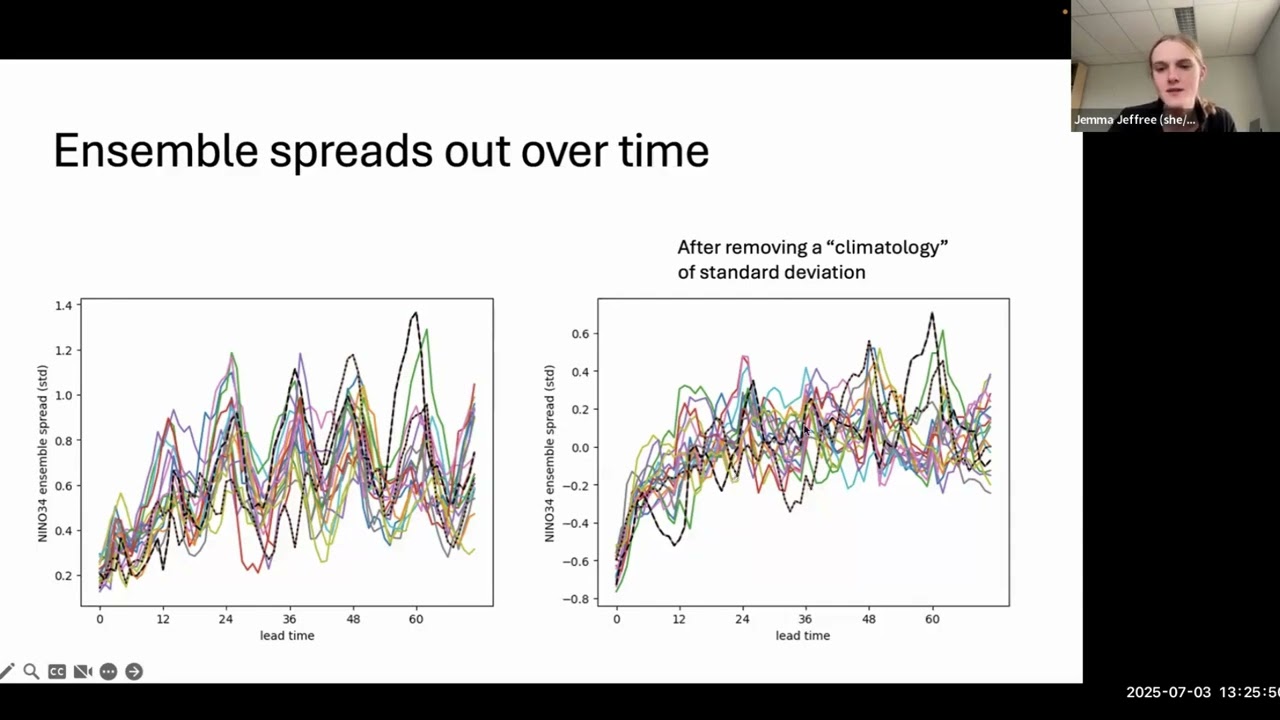
  • The CMIP decadal forecast simulations are impacted by model drift from the observational initial conditions, and by the climate change signal caused by historical forcings. These can cause spurious predictability long into the simulations, making analysis of predictability difficult.

  • This project involves using similar types of ensembles, which branch off the PI control simulation, in order to study predictability limits without complications from these extra signals.

  • Ensembles of 10 members each were run, branching from the ESM1.5 PI experiment at 5 year intervals and running for 6 years. In total, giving 200 simulations of 6 years each.

Results:

  • The NiĂąo 3.4 predictability limit was found to be between 1.5 to 2.5 years.
  • Initialising during La NiĂąa’s appeared to give stronger predictability after 1 year, contrary to most of the literature. It’s unclear whether this is ACCESS specific.
  • The ensemble may be useful for diagnosing conditions mechanisms leading to particular events including strong El NiĂąos or La NiĂąas. However, it’s challenging to separate these from the noise among ensemble members.

Data:

  • The output from these experiments is currently on the scratch space. @jemmajeffree is deciding which outputs to keep when moving the data to longer term storage. If you would be interested in using any of the output from these runs, feel free to contact @jemmajeffree.

3. CMIP7 experiments table

@RachelLaw has created a table here to coordinate community contributions to the CMIP7 fast track experiments. If you would be interested in running additional ensemble members for any of the listed experiments, add a line below the relevant experiment with your details.

Additional information

Date: 17/07/2025
Chair: @eunpalim
Participants: 10

1. Admin and resource usage

  • Science Presentations: We currently have no upcoming presentations scheduled. Presentations from recent conferences and workshops are welcome, as are updates on in progress work. Members encouraged contact the ESM WG co-chairs or @spencerwong to propose a topic.

  • LG87 Resource Usage:

    • Our allocation for the July-August quarter is 875 KSUs. @wghuneke will use 500KSU to run a PI control simulation with 0.25 degree CM2. Output from theses simulations will be kept on gdata/lg87 for some time and will be available to the community for analysis. This post is open for discussion on which output to save.
    • If you have any experiments you are interested in running with ESM WG resources, follow the proposal guidelines here to apply to use WG compute. Members are encouraged to apply for resources early in the quarter, as there may be opportunities to obtain more resources later in the quarter.
    • Storage usage at 56.44 TB of 100 TB allocation.

2. 2025 ACCESS Community Workshop discussion

  • 7 talks have been assigned to the ESM Working Group. A CMIP7 focussed discussion is still an option for the remaining time. Another option is to hold a half day meeting, and coordinate with the other working groups so that members can attend multiple meetings. The option of a social event in the afternoon was also raised.

3. CMIP7 development update

@tiloz presented on the latest model developments for ESM1.6.

  • The new June spinup simulation includes several minor code changes, including updated diagnostics and technical changes to the phenology implementation. Science changes include updated Wombat parameters, and swapping over to the CMIP7 greenhouse gas and aerosol forcings. This simulation looks quite stable however is still adjusting to the change in solar constant.
  • Ongoing includes updates to the plant functional types. Parameters for new Australia specific plant functional types are being finalised. Investigation into issues with seasonality, water balance, and the interpretation of land use change datasets is also being carried out.
  • On the ocean side, CICE5 gives similar results, and testing is underway for fixes to the Mediterranean salinity issue.
  • New oneAPI compiler is being tested, and initial performance concerns have been alleviated with the latest versions.
  • Additional simulations being run include: a 4xCO2 run, a 1pct CO2 run, an emissions driven control, and an AMIP simulation.

There is interest in getting community help to run additional experiments. If you are interested in running any Fast Track experiments, please add your name to the table here

4. ACCESS NRI Visualisation Project: call for expressions of interest

5. ACCESS NRI Visualisation Project: call for expressions of interest

The ACCESS NRI work plan includes the release of additional Payu based ESM1.5 configurations. A discussion was held on which configurations community members would like to see prioritised. These included the basic set of Deck experiments, including the AMIP configuration. Interest was also raised in an N48 configuration for faster simulations.

Please feel free to correct any mistakes in these notes directly, or message @spencerwong with corrections.

Additional information

Date: 14/08/2025
Chair: @ShayneM
Participants: 20

1. Admin and resource usage

  • Science Presentations: We currently have no upcoming presentations scheduled. Presentations from recent conferences and workshops are welcome, as are updates on in progress work. Members encouraged contact the ESM WG co-chairs or @spencerwong to propose a topic.

  • LG87 Resource Usage:

    • Our allocation for the July-August quarter is 875 KSUs. @wghuneke @ShayneM are running experiments this quarter.
    • If you have any experiments you are interested in running with ESM WG resources, follow the proposal guidelines here to apply to use WG compute. Members are encouraged to apply for resources early in the quarter, as there may be opportunities to obtain more resources later in the quarter.
    • Storage usage at 62 TB of 100 TB allocation.

2. 2025 ACCESS Community Workshop

  • A brief discussion was held on the format of the ACCESS Community Workshop working group day. It was brought up that having simultaneous working group meetings can lead to people missing out other meetings of interest, especially for ESM WG members who often are involved in multiple working groups. Discussion is ongoing on the format of next year’s workshop to address these issues.

3. CMIP7 development update

@tiloz presented on the latest model developments for ESM1.6.

  • A new spinup simulation “AugustSpinup” has been started, which includes the switch to CICE5 among various technical changes.
  • A current issue is the continued drift in whole of ocean temperature, which began with the transistion to the CMIP7 solar constant. Drift has continued past what was originally expected. Cooling occurs in the deep ocean, and increased deep convection has been noticed in the Weddell Sea. The iceberg melt scheme was discussed as a potential contributor.
  • Approaches to address the drift were brought up, including adjusting the ocean albedo. Concerns with various approaches were raised.
  • It may be beneficial to form a subgroup to continue the discussion on how to best address the model drift.

Please feel free to correct any mistakes in these notes directly, or message @spencerwong with corrections.

Additional information

Date: 28/08/2025
Chair: @dkhutch
Participants: 18

1. Admin and resource usage

  • Science Presentations: We currently have no upcoming presentations scheduled. Presentations from recent conferences and workshops are welcome, as are informal updates on in progress work. Members are encouraged contact the ESM WG co-chairs or @spencerwong to propose a topic.

  • LG87 Resource Usage:

    • End of quarter rebalancing has allocated an additional 437.5 KSU to the ESM WG, as the original allocation had been used up. It’s good to run experiments early in the quarter, as resources can be reallocated at the end of the quarter if available.
    • If you have any experiments you are interested in running with ESM WG resources, follow the proposal guidelines here to apply to use WG compute. Members are encouraged to apply for resources early in the quarter, as there may be opportunities to obtain more resources later in the quarter.
    • Storage usage at 62 TB of 100 TB allocation. A stocktake of older data might be required to see if any could/should be shifted off gdata/lg87.

3. Science presentation

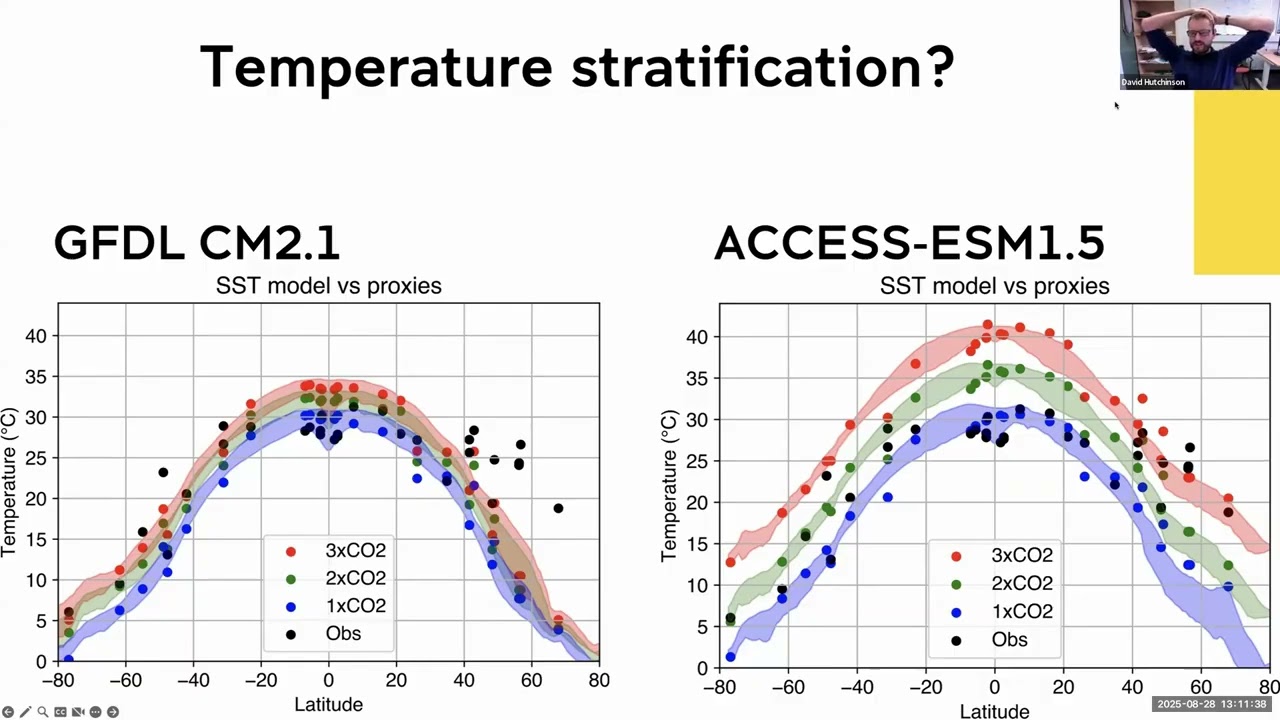
@dkhutch presented an Update on Miocene simulations using ACCESS-ESM1.5

Introduction

  • Previous Miocene simulations had been run using the GFDL model using two different topography reconstructions – the Burls et al (2021) dataset used in MIOMIP, and the Straume et al (2020) dataset which may contain more accurate Atlantic-Arctic gateways. These simulations suggested that the Miocene was close to a transition between PMOC and AMOC states.
  • This project aims to run similar simulations using ACCESS-ESM1.5, using 1x, 2x and 3x CO2.

Results

  • ESM 1.5 was run using the Burls et al (2021) topography with initial conditions from the spun-up GFDL model.
  • Deep ocean ventilation was of particular interest, as it responded differently to CO2 levels compared to the GFDL model. In ACCESS-ESM1.5, deep water formation was killed when using 2xCO2 and 3xCO2. One cause may be the model’s higher climate sensitivity.
  • Several modifications were made to the initial conditions to try and kick start the deep water formation:
    • Reducing the initial stratification by bumping up the deep ocean temperature, and using an idealised temperature/salinity profile were both unsuccessful.
    • A hard reset of temperature and salinity to constant values was more successful, and produced increased ventilation at the start of the runs. However overturning in the southern ocean eventually decayed in the higher CO2 cases.

Conclusions

  • ACCESS-ESM1.5 is resistant to producing Southern Ocean deepwater under higher CO2, even when initial conditions have been created to favour deep water formation.
  • Transplanting initial conditions from a spun-up model to another model may not work well especially if the climate sensitivities don’t match.
  • This work has produced interesting Miocene configurations displaying different levels of stratification and ventilation. These will be useful for future work investigating rapid warming, de-oxygenation, and AMOC collapse.

See here for further background on the Miocene experiments!

Please feel free to correct any mistakes in these notes directly, or message @spencerwong with corrections.

Additional information

Date: 25/09/2025
Chair: @dkhutch
Participants: 16

1. Admin and resource usage

  • Science Presentations: There are currently no science presentations scheduled. If you have any work you would be interested in presenting, contact any of the ESM WG co-chairs or @spencerwong. Presentations from recent conferences and workshops are welcome, as are informal updates on in progress work. Students and early career researchers are especially encouraged to give presentations.

  • Change of working group co-chairs: @eunpalim will be completing her role as a ESM WG co-chair and the position will be taken up by @ctychung.

  • LG87 Resource Usage:

    • The ESM WG compute allocation was increased for quarter 2 to 1.3MSU. This has been used up, and the allocation will be reset to the default 875KSU on 1 Oct.
    • If you have any experiments you are interested in running with ESM WG resources, follow the proposal guidelines here to apply to use WG compute. Members are encouraged to apply for resources early in the quarter, as there may be opportunities to obtain more resources later in the quarter.
    • Storage usage at 65 TB of 100 TB allocation. In the future, we may require long term planning to manage the storage resources.

2. Proposed ESM1.5 infrastructure changes

  • @spencerwong and @manodeep discussed recent work on optimising ESM1.5 and 1.6.

  • Infrastructure updates to ESM1.6 include compiler changes, queue and layout changes, and updates to communication libraries. These changes improved ESM1.6’s walltime and running cost.

  • Back-porting the updates to ESM1.5 would reduce walltimes for a year of simulation from 65.9 to 58.4 minutes (21.9 years/day → 24.7 years/day) and service unit cost from 950 to 810 SU/year.

  • These infrastructure updates would change answers produced by the model. These have not been specifically tested with ESM1.5, however tests using ESM1.6 suggest that answer changes fall within the model’s internal variability.

  • Model determinism is not impacted: repeating a simulation multiple times with the new version will still produce identical answers.

  • Discussion:

  • Members were interested in seeing these changes added to a new release, as long as previous releases remain available for continuing older experiments.

  • Members were interested in further opportunities for optimisation, including vectorisation which may be able to improve performance. This would lead to further numerical changes, however should still maintain determinism. Scaling studies are also being worked on to assess how changing the number of CPUs affects model speeds.

  • Producing multiple versions with different optimisations, with different levels of reproducibility were also discussed.

  • Switching off the carbon cycle may be an additional way to improve performance.

Discussion on collaborative CM3 evaluation

  • @wghuneke presented on a proposed framework for CM3 evaluation.

  • The long term goal is to produce a peer reviewed evaluation publication, with an interim goal of helping with model development and tuning. Evaluation work on CM3 can then be leveraged in the future for CM3.

  • The aim is to work collaboratively, where everyone is welcome to contribute to the evaluation. A GitHub repository will be set up where members can contribute analysis notebooks create GitHub issues for discussing different diagnostics. ESM Working Group meetings can also be used to discuss progress and the analysis.

  • Aiming to hold a hackathon around CM3 evaluation next year.

  • Existing OM3 analysis scripts will be a useful starting point.

  • Technical points around data availability, standardisation, and CMORisation were discussed.

  • There will be a meeting to plan the evaluation framework on Zoom on Wed 8 Oct at 11:30. Anyone is welcome to join – meeting details are available in this topic

Additional information

Please feel free to correct any mistakes in these notes directly, or message @spencerwong with corrections.

1 Like

Date: 09/10/2025
Chair: @tiloz
Participants: 14

Quick recap

The working group discussed changes to their meeting format and resources, including alternating between evaluation-focused sessions and broader topic discussions, while reminding participants about available computing power and storage allocations. The meeting focused on the CM3 model evaluation process, covering model development support and publication-focused evaluation phases, with discussions about GitHub repositories and analysis workflows. The group addressed meeting structure and naming changes, workflow contributions, and the importance of community involvement, while emphasizing the need for flexible participation options and clear communication channels.

Next steps

  • @cbull to share the GitHub repository link for CM3 analysis with the community
  • NRI team to set up automated figure generation and data storage for CM3 diagnostics
  • NRI team to consider implementing email notifications for new data releases
  • @ctychung to upload ENSO recipes to the GitHub repository
  • @cbull to show community members how to set up GitHub notifications
  • @MartinDix to reorganize coupled model meetings with a structured agenda and minutes
  • NRI team to consider setting up a SharePoint folder for publicly accessible figures
  • Community members to fill out the poll regarding potential changes to ESM Working Group meeting time
  • NRI team to provide a detailed walkthrough of the GitHub workflow at the next ESM Working Group meeting
  • NRI team to consider implementing a “watch” system for relevant Hive forum discussions to notify interested parties

Summary

Meeting Format and Resource Updates

The working group discussed changes to their meeting format, including potentially alternating meetings between evaluation-focused sessions and broader topic discussions, with a focus on including CM3 and ESM3 model evaluations.

They reminded participants about available resources, including 1.1 MSU of allocated computing power and 65 terabytes of storage, with guidelines available for accessing these resources. The group also encouraged members to submit work for presentation, particularly related to access models.

CM3 Model Evaluation Process

The meeting focused on the CM3 model evaluation process, which is divided into two phases: supporting model development through the rest of the year and into next year, and a later phase focused on evaluating a frozen model configuration for publication. A GitHub repository has been created for sharing analysis code and figures, while the ESM Working Group meetings will be used to discuss analysis results and address issues. The Ocean Team technical working group at NRI meets fortnightly and is open for anyone to attend and a similar invitation may follow (if there is interest) for the ACCESS-NRI CM3 dev meetings; most discussions will occur in the ESM Working Group meetings.

There was a kick-off CM3 evaluation group meeting the day before: see minutes on the forum.

CM3 Evaluation Repository Setup

The meeting discussed the setup of an evaluation repository for CM3, focusing on essential and bonus analysis. @cbull emphasized the importance of community expertise in enhancing model relevance and mentioned ongoing work to address data gaps. @wghuneke outlined the restructuring of ESM working group meetings, alternating between CM3 evaluation and science-focused discussions, and proposed a poll to determine a new meeting time. The group also discussed the need for technical input and the sharing of model outputs and GitHub repository information.

Refining ESM Meeting Structure

The meeting focused on the structure and naming of model development and evaluation meetings. @Dietmar_Dommenget suggested changing the name from “ESM Evaluation” to “ESM Development” to better reflect the collaborative nature of the process and encourage scientific involvement. @cbull and @MartinDix discussed the possibility of publishing meeting agendas and minutes to improve transparency and participation. @ongqingyee raised concerns about the time commitment required for CM3 output analysis, suggesting entraining more ECRs who are interested in CM3 development to participate. This would enable scientists with expertise but less time to still partake in technical discussion without having to do analysis themselves.

CM3/ESM3 Contribution Workflows Discussion

The meeting focused on discussing workflows and contributions for the CM3/ESM3 evaluation. @cbull explained that while GitHub is the primary platform for code sharing and analysis, there are flexible options for community members to contribute, including uploading figures without full code integration. The group discussed automation possibilities, with @Dietmar_Dommenget suggesting that diagnostic data should be stored alongside figures to enable further analysis, and @ctychung highlighting the need for clear communication about updates and notifications. The conversation ended with agreement that while GitHub and the Hive platform are valuable tools, there should also be options for verbal contributions and discussions during ESM working group meetings.

Additional information

These meetings notes were generated automatically. Please feel free to correct any mistakes in these notes directly, or message @Aidan with corrections.

Date: 20/11/2025
Chair: @dkhutch
Participants: 12

1. Admin and resource usage

  • Science Presentations: If you have any recent work that you would like to share during the ESM WG meetings, contact the ESM WG co-chairs or @spencerwong. Presentations from recent conferences and workshops are welcome, as are informal updates on in progress work.

  • LG87 Resource Usage:

    • Compute resources for the lg87 project are currently under utilised for this quarter, with ~850 KSU unused. New simulations have recently begun, and we expect to use up the remaining allocation by the end of the year.
    • If you have any experiments you are interested in running with ESM WG resources, follow the proposal guidelines here to apply to use WG compute. Members are encouraged to apply for resources early in the quarter, as there may be opportunities to obtain more resources later in the quarter.
    • Storage usage at 65 TB of 100 TB allocation.

2: Technical issues

  • Members reported crashes during the netCDF conversion in CM2 runs after swapping to the xp65 environment. ACCESS-NRI is looking into the issue.
  • Problems were also raised around the umfile_utils scripts on gdata/access. These currently rely on the removed hh5 environment and will need to be updated.

3. Science presentation

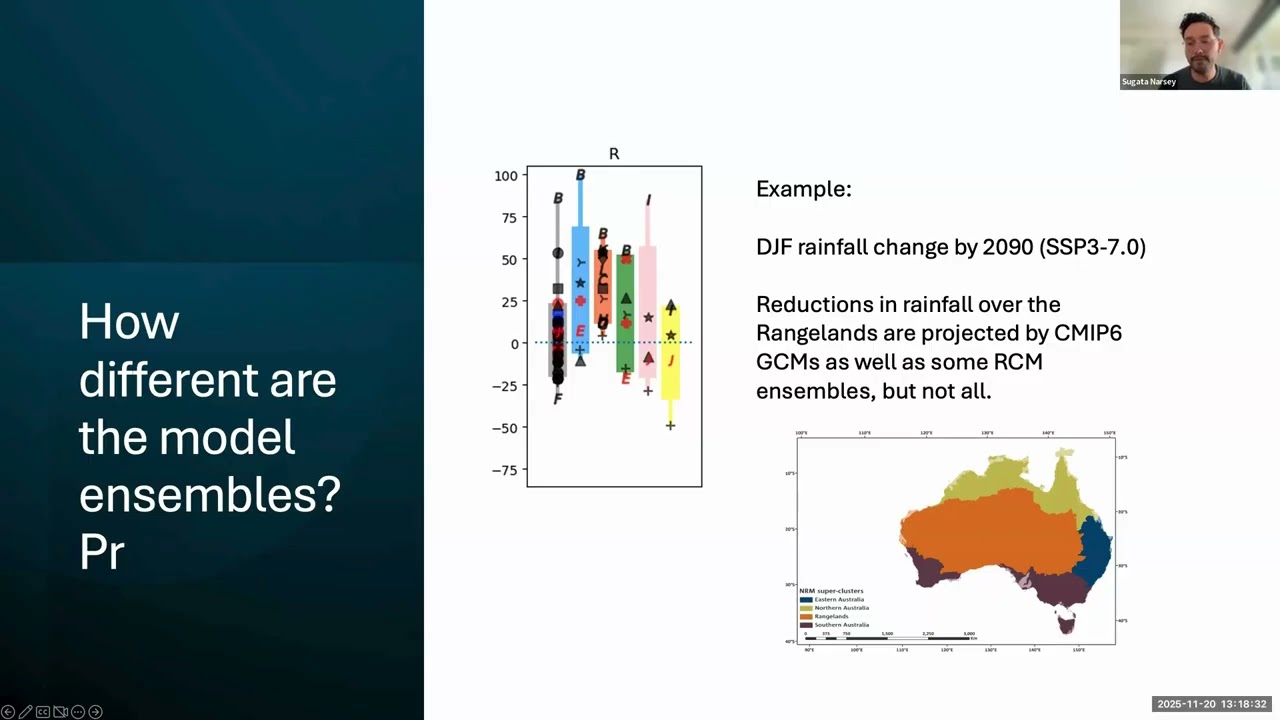
Sugata Narsey from the Bureau of Meteorology presented an Disentangling the uncertainties in regional projections for Australia

Introduction

  • An abundance of climate projection data is available for users, stemming from a wide range of GCMS, RCMs, scenarios, and post-processing techniques. However, large uncertainties are present in these projections.
  • Focusing on regional temperature and rainfall projections over Australia, this project seeks to understand the causes of this uncertainty.
  • Region average projections for 4 natural resource management (NRM) were analysed, using data from 35 GCMs, 4 RCMs, and 3 scenarios.

Results

  • Projections of temperature change were strongly influenced by both the scenario and the climate sensitivity of the driving GCM. Meanwhile, the choice of scenario had little impact on rainfall projections, which showed a stronger dependence on the choice of GCM.
  • Projections were also influenced by the choice of RCM. Failing to sample a range of RCMs when using projection data would result in important uncertainties being omitted.
  • RCMs were found to both increase, decrease, and even change the sign of projections compared to their driving GCM, and these changes were not systematic.
  • Changes in rainfall variability were highly inconsistent across the regional and global models investigated.
  • To properly account for these uncertainties, users of projections data should include data from a wide range of GCMs and RCMs.

Please feel free to correct any mistakes in these notes directly, or message @spencerwong with corrections.

Additional information

Date: 4/12/2025
Chair: @ShayneM
Participants: 15

1. Admin and resource usage

  • Science Presentations: We’re looking to schedule in science presentations for early next year. If you have any work that you would like to share during the ESM WG meetings, contact the ESM WG co-chairs or @spencerwong. Presentations from recent conferences and workshops are welcome, as are informal updates on in progress work.

  • LG87 Resource Usage:

    • A couple hundred KSU from the WG allocation still remain, but these will be used up by already running experiments.
    • It’s a good time to put in any experiment proposals for next quarter. Having early proposals helps with allocating working group resources. If you have any experiments you are interested in running with ESM WG resources, follow the proposal guidelines here to apply to use WG compute.
    • Storage usage at 65 TB of 100 TB allocation.

2: 2026 CMIP7/ESM focused workshop

  • ACCESS NRI is planning on hosting a CMIP7/ESM focussed workshop in Melbourne in early September 2026.
  • This will include a hackathon/training day, and two days of workshop.
  • A major goal will be to strengthen connections across the ESM and Land Working Groups, and will cover a range of topics including model development, model evaluation, and experiments for better understanding the model.
  • We are currently looking for people to join the organising committee, and are aiming for the committee to comprise researchers with a range of research focuses, career stages, and genders. Contact one of the co-chairs @dkhutch, @ctychung, @tiloz, @ShayneM or @spencerwong if you are interested in joining the organising committee.

3. Support for data sharing and storage

  • ACCESS-NRI is working to improve the options available for storing and sharing data.
  • A new system will come online early 2026, and will consist of 3 tiers of data storage: Working group resources designed for short term storage (3-12 months), a ACCESS-NRI data sandbox for data widely used across the community (1-2 years), and publication through NCI’s data repository sandbox (yrs+).
  • Documentation on using the different tiers will be available early next year, and @kdruken and @joshuatorrance will be available present more details at a future ESM WG meeting.

3. Science presentation

Dakuan Yu from the Max Planck Institute for Meteorology presented on ENSO Optimisation in ICON XPP Earth System Model.

(Recording to be uploaded shortly)

Introduction

  • The ICON model is the latest climate model developed at MPI. Key new features include an isocahedral (soccer ball) grid, use of non-hydrostatic dynamics, and unifying NWP and climate prediction. The ICON XPP (Extended Prediction and Projection) model is being developed for a range of timescales, from seasonal to decadal.
  • While ENSO is a key part of the climate system, it’s representation in climate models is far from perfect.
  • This talk describes parameter optimisation work used to improve ENSO in the ICON XPP model.

ENSO biases in the ICON XPP model

  • The CLIVAR ESNO Metrics Package (Yann et al.) includes metrics for evaluating ENSO climatology, variability, and processes.
  • At the start of this project, the ICON XPP model showed problems in all these areas, including precipitation, ENSO amplitude, seasonality, skewness, pattern, as well as wind-SST and SST-heat flux feedbacks.

Tuning in an AMIP configuration

  • A cost function was developed which combines the different metrics and 21 tuning parameters.
  • Tuning the parameters to optimise this cost function worked well with the AMIP configuration, and several of the biases were successfully reduced.
  • Sensitivity analysis found the 6 most important tuning parameters.

Tuning the coupled model

  • The 6 parameters identified during the AMIP tuning were then optimised in a coupled configuration.
  • This improved the SST bias, ENSO amplitude, seasonality, ENSO duration, and wind-SSH feedback. However large errors for the double ICTZ bias, precipitation, and skewness.
  • In aggregate, the climatology metrics were not improved much, but the performance and feedback errors were significantly reduced.
  • While ENSO metrics were improved, global mean temperature increased. Further analysis found which parameters GMT was sensitive to, and these were retuned to optimise both GMT and ENSO together.

Conclusions

  • The tuning approach successfully improved several of the ENSO metrics. The improvements were roughly equivalent to those from doubling the resolution. However, biases remained in several of the metrics.

Please feel free to correct any mistakes in these notes directly, or message @spencerwong with corrections.

Additional information